Journées annuelles de la fédération occimath

Europe/Paris
Salle de cours 10.01 (Campus TRIOLET Bâtiment 10)

Salle de cours 10.01

Campus TRIOLET Bâtiment 10

Université de Montpellier Tramway ligne 1 direction Mosson, arrêt Saint-Éloi
Description


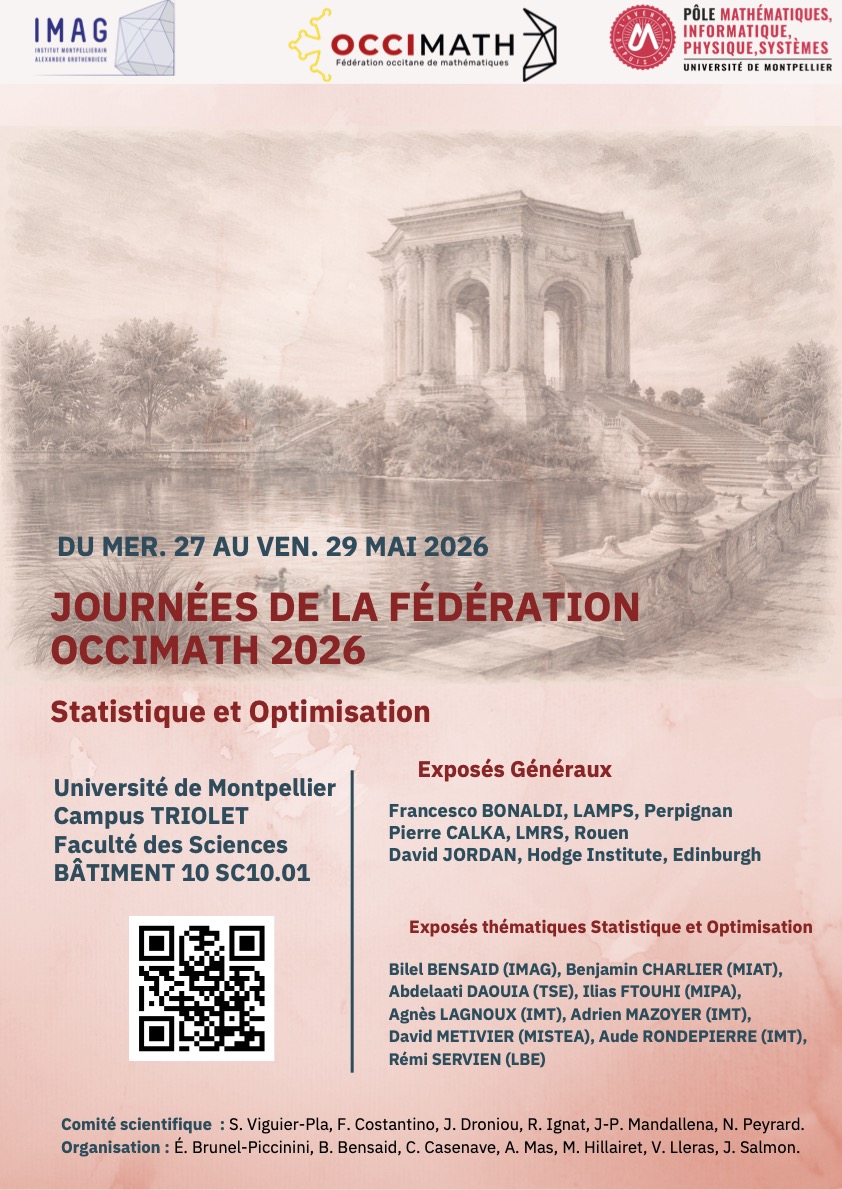
La Fédération Occitane de recherche Mathématique organise ses journées annuelles du 27 au 29 mai 2026 à l'IMAG.

Le 27 mai sera l'occasion de trois interventions par des invités de la fédération :


Les 28-29  mai seront dédiés à un tour d'horizon des activités scientifiques de la fédération sur la thématique "statistique et optimisation". Les intervenants seront


Comité scientifique :

  • F. Costantino (IMT)
  • J. Droniou (IMAG)
  • R. Ignat (IMT)
  • J.-P. Mandallena (MIPA)
  • N. Peyrard (MIAT)
  • S. Viguier-Pla (LAMPS, Présidente)


Comité d'organisation: 

  • E. Brunel-Piccinini (IMAG)
  • B. Bensaid (IMAG)
  • C. Casenave (MISTEA)
  • M. Hillairet (IMAG)
  • V. Lleras (IMAG)
  • A. Mas (IMAG)
  • J. Salmon (IMAG)


    • 1
      Energy-consistent modeling and simulation of stents in arterial tissues Salle de cours 10.01

      Salle de cours 10.01

      Campus TRIOLET Bâtiment 10

      Université de Montpellier Tramway ligne 1 direction Mosson, arrêt Saint-Éloi

      In this talk, we focus on the modeling and simulation of large-strain (hyperelastic) elasticity problems, with particular application to the study of soft biological tissues. We also consider frictional contact between two hyperelastic bodies, with application to the deployment of a stent in an arterial tissue. For the numerical approximation, the key idea is to design a time integration scheme consistent with the energy of the system on the continuous level: that is, conserving energy in the frictionless contact case, and such that no numerical dissipation is introduced in the frictional and, possibly, viscosity cases. The numerical approximation of frictional contact is accomplished using a Primal–Dual Active Set method, without the need to introduce Lagrange multipliers. Numerical simulations are performed on academic and real-world scenarios; in particular, the latter concerns the representation of the deployment of a stainless steel stent in contact with an arterial tissue. The talk is based on joint works with Mikaël Barboteu, Serge Dumont, Rawane Mansour, Vo Anh Thuong Nguyen, and Thach-Hoang Nguyen.

      Orateur: Francesco BONALDI
    • 2
      Événements exceptionnels en géométrie aléatoire convexe Salle de cours 10.01

      Salle de cours 10.01

      Campus TRIOLET Bâtiment 10

      Université de Montpellier Tramway ligne 1 direction Mosson, arrêt Saint-Éloi

      Dans cet exposé, nous construisons des objets géométriques aléatoires à partir de la donnée d'un processus ponctuel de Poisson dans l'espace euclidien et cherchons à estimer la probabilité d'événements rares, c'est-à-dire de configurations géométriques exceptionnelles. Nous décrivons trois exemples : tout d'abord, nous générons une partition aléatoires de l'espace en polyèdres convexes, dite de Poisson-Voronoi, et étudions la probabilité qu'un de ces polyèdres soit anormalement allongé via la queue de distribution de la distance maximale d'un sommet au germe d'une cellule typique. Dans une seconde partie, nous nous intéressons à l'enveloppe convexe d'un grand nuage de points contenu dans un corps convexe à bord lisse et considérons les valeurs extrêmes des aires des facettes du polyèdre obtenu. Nous obtenons en particulier des résultats d'approximation poissonnienne et de forme limite. Enfin, nous construisons un modèle de recouvrement de l'espace par des boules de rayon fixe centrées en les points d'un processus ponctuel de Poisson homogène et calculons la probabilité qu'une composante connexe de ce recouvrement contienne un nombre anormalement petit de boules lorsque l'intensité tend vers l'infini. Nous en donnons en particulier un développement à deux termes, relié à l'enveloppe convexe des points poissonniens qui la constituent.
      Cet exposé est basé sur des travaux communs avec Audrey Chaudron, Cecilia D'Errico, Nathanaël Enriquez et Joe Yukich.

      Orateur: Pierre CALKA
    • 16:00
      Pause Salle de cours 10.01

      Salle de cours 10.01

      Campus TRIOLET Bâtiment 10

      Université de Montpellier Tramway ligne 1 direction Mosson, arrêt Saint-Éloi
    • 3
      A mathematician's view on symmetries of quantum fields Salle de cours 10.01

      Salle de cours 10.01

      Campus TRIOLET Bâtiment 10

      Université de Montpellier Tramway ligne 1 direction Mosson, arrêt Saint-Éloi

      The past four decades have witnessed a vibrant and profound dialog between mathematics and quantum physics. The fundamental driving challenge here is how to reconcile the rigid algebraic structures of quantum physics with the geometric fluidity of relativistic spacetime. It turns out that such questions, and their as yet woefully incomplete answers, are as illuminating within pure mathematics as they are in quantum physics.
      In this talk I will highlight one key aspect of this dialog: symmetry. Our traditional mathematical notions of symmetry -- think groups, matrices, diffeomorphisms, etc. -- always exist and compose discretely and linearly through time: first f then g, then h. By contrast, symmetries of quantum fields permeate both time and space, where they can wiggle, bend and break. This challenges us as mathematicians to rethink our whole notion of symmetry! Wandering down this path leads us deep into purely mathematical terrain -- to the heart of modern category theory, representation theory, even number theory.

      Orateur: David JORDAN
    • 19:30
      DINER Le Faune, 13 rue de la République, 34000 Montpellier

      Le Faune, 13 rue de la République, 34000 Montpellier

      https://faunemoco.com/

    • 4
      Spectral diagonalization in high dimensions and its implications for learning dynamics Salle de cours 10.01

      Salle de cours 10.01

      Campus TRIOLET Bâtiment 10

      Université de Montpellier Tramway ligne 1 direction Mosson, arrêt Saint-Éloi

      We study the spectral structure of Gram matrices arising in high-dimensional learning problems and its implications for optimization dynamics. First, we prove that for independent, centered, anisotropic vectors, the normalized Gram matrix converges to the identity in operator norm, under mild assumptions on intrinsic dimension and tail behavior. This extends classical isotropic results to a broad non-homogeneous setting.

      Second, we analyze random feature models and show that Gram matrices converge to the kernel matrix for a large range of activation functions. Combining this with the anisotropic result, we show that, in many regimes of interest, correlations vanish, leading to an approximate (block-)diagonalization of the kernel.

      Finally, we leverage these spectral results to study gradient flow dynamics for least-squares objectives. We prove a decoupling property, showing that the dynamics asymptotically behave as independent one-dimensional processes, with a block structure in the presence of statistical dependencies. This provides a theoretical explanation for "task arithmetic" and the "absence" of interference in overparameterized models.

      Our results unify independence-based and geometry-based mechanisms for decoupling, and apply to random features and structured data such as mixtures.

      Orateur: Bilel BENSAID
    • 5
      Geometric properties of optimizers for the maximum gradient of the torsion function via probabilistic approaches Salle de cours 10.01

      Salle de cours 10.01

      Campus TRIOLET Bâtiment 10

      Université de Montpellier Tramway ligne 1 direction Mosson, arrêt Saint-Éloi

      We consider the shape optimization problem of looking for the shape that maximizes the maximal norm of the gradient of the torsion function among planar convex sets with a prescribed measure (or perimeter). We prove the existence of such a shape and prove that its boundary is C^1 regular. Then, we show that its boundary contains a segment. The proofs are mainly based on probabilistic arguments and a novel version of the boundary Harnack principle for the torsion function. This is a work in collaboration with Krzysztof Burdzy (University of Washington) and Phanuel Mariano (Union College).

      Orateur: Ilias FTOUHI
    • 10:40
      Pause Salle de cours 10.01

      Salle de cours 10.01

      Campus TRIOLET Bâtiment 10

      Université de Montpellier Tramway ligne 1 direction Mosson, arrêt Saint-Éloi
    • 6
      Un tour d’horizon des résultats récents sur les algorithmes inertiels dans un cadre déterministe Salle de cours 10.01

      Salle de cours 10.01

      Campus TRIOLET Bâtiment 10

      Université de Montpellier Tramway ligne 1 direction Mosson, arrêt Saint-Éloi
      Orateur: Aude RONDEPIERRE
    • 12:00
      Pause Repas Campus Triolet

      Campus Triolet

    • 7
      Cross-Modality Alignment for Integration of Spatial Omics Data Salle de cours 10.01

      Salle de cours 10.01

      Campus TRIOLET Bâtiment 10

      Université de Montpellier Tramway ligne 1 direction Mosson, arrêt Saint-Éloi

      Abstract: Advances in spatial omics sequencing now enable acquisition of massive subcellular-scale datasets (millions of reads with hundreds of detectable genes). However, heterogeneity in measured features, spatial resolution, and physical sampling scope across technologies and experimental protocols introduces significant challenges for integrating these datasets within reference coordinate systems and across biological scales.

      In this presentation, I will describe a set of technologies implemented in the xIV-LDDMM Toolkit Python package [2], developed for mapping data across scales and modalities as, for instance, aligning gene-level measurements to 2D or 3D tissue structures. I will first introduce the varifold-based distance and deformation framework, which enables comparison of diverse data types in spatial omics [1]. I will then focus on dimensionality-reduction strategies (both spatial and gene-wise) designed to reduce the computational burden of these large datasets.

      Orateur: Benjamin CHARLIER
    • 8
      Optimizing prior knowledge integration in regression-based gene network inference Salle de cours 10.01

      Salle de cours 10.01

      Campus TRIOLET Bâtiment 10

      Université de Montpellier Tramway ligne 1 direction Mosson, arrêt Saint-Éloi

      The growing availability of diverse omics datasets motivates integrative approaches for gene regulatory network inference.
      Regression-based methods for gene regulatory network inference (Inferelator, GENIE3, DynGENIE3, IRafNet) identify key regulators and can incorporate prior knowledge to guide variable selection.
      We propose a method to tune the strength of prior knowledge integration in regression models such as Lasso and Random Forests, using null hypothesis simulations to balance prior information with data-driven inference.

      Orateur: Sophie LEBRE
    • 15:40
      Pause Salle de cours 10.01

      Salle de cours 10.01

      Campus TRIOLET Bâtiment 10

      Université de Montpellier Tramway ligne 1 direction Mosson, arrêt Saint-Éloi
    • 9
      Time series forecasting with hybrid physics-data models: application to lake thermal stratification Salle de cours 10.01

      Salle de cours 10.01

      Campus TRIOLET Bâtiment 10

      Université de Montpellier Tramway ligne 1 direction Mosson, arrêt Saint-Éloi

      Forecasting the future state of a dynamical system from observed time series is a central problem across science and engineering.
      Classical autoregressive models offer simplicity and interpretability but struggle with complex nonlinear dynamics.
      Deep learning architectures such as Recurrent Neural Networks overcome this limitation yet offer no physical guarantees, leading to unphysical extrapolations beyond the training window.
      Hybrid approaches have emerged to combine the strengths of both paradigms: Physics-Informed Neural Networks (PINNs) incorporate known laws as penalty terms in the training loss, while Neural ODEs and Universal Differential Equations (UDEs) embed physical structure directly inside a differential equation.
      In this talk, we present these different approaches and apply UDEs to forecasting water temperature at multiple depths in Lake Créteil (Paris region), where thermal stratification is crucial for predicting harmful algal blooms.
      We benchmark the UDE against physics-based models and deep learning approaches, and also discuss the training methodology and new physics-coupling designs that improve learning.

      Orateur: David METIVIER
    • 10
      Extreme value inference for heterogeneous heavy-tailed data: A derandomization theory Salle de cours 10.01

      Salle de cours 10.01

      Campus TRIOLET Bâtiment 10

      Université de Montpellier Tramway ligne 1 direction Mosson, arrêt Saint-Éloi

      When assessing extreme risks, several risk measures depend on extreme value parameters that can be estimated via empirical mean excesses. A key mathematical challenge in studying these estimators is their reliance on high-order statistics above a random threshold. In this talk, we use simple yet novel derandomization arguments to derive the joint asymptotic distribution of these tail empirical excesses and Expected Shortfall with the underlying threshold level. This high-level result allows for a strong degree of heterogeneity in the data-generating process as well as serial dependence. In the case of independent observations with a heavy-tailed average distribution, we obtain asymptotic normality results for the Hill estimator of the extreme value index, the Weissman estimator of extreme quantiles, and two estimators of Expected Shortfall above an extreme level. These results hold under substantially weaker, yet easily verifiable and interpretable conditions than those in the recent literature. In particular, we establish explicit closed-form expressions for the asymptotic bias and variance of each estimator. Our assumptions hold in a wide range of models where existing results may not apply, including scenarios of contaminated samples. We illustrate the practical consequences of our results on simulated data and a real data application to financial risk management. If time permits, we also discuss extensions of this derandomization approach to multivariate data.

      Orateur: Joseph Hachem (Toulouse School of Economics)
    • 11
      Efficient estimation of Sobol' indices of any order from a single input/output sample Salle de cours 10.01

      Salle de cours 10.01

      Campus TRIOLET Bâtiment 10

      Université de Montpellier Tramway ligne 1 direction Mosson, arrêt Saint-Éloi
      Orateur: Agnès LAGNOUX
    • 10:40
      Pause Salle de cours 10.01

      Salle de cours 10.01

      Campus TRIOLET Bâtiment 10

      Université de Montpellier Tramway ligne 1 direction Mosson, arrêt Saint-Éloi
    • 12
      An alternative ranking system for biathlon pursuit races Salle de cours 10.01

      Salle de cours 10.01

      Campus TRIOLET Bâtiment 10

      Université de Montpellier Tramway ligne 1 direction Mosson, arrêt Saint-Éloi

      Biathlon is an Olympic sport combining cross-country skiing with rifle shooting, giving a penalty for each target miss. The biathletes ran different race formats, including the pursuit race. During this race, the biathletes chase the leader with a start time identical to the result of the sprint race previously achieved. So, pursuit involves different skills (such as tactics or management of emotional pressure) that are not present during races with an interval-start procedure like sprint. Nevertheless, final pursuit rankings are strongly correlated to sprint ones, which prevents a spectacular comeback after a disappointing sprint race. We present here an alternative pursuit ranking system that is nearly decorrelated to sprint rankings. This simple ranking system is based on comparisons with previous pursuit results. The current and the alternative rankings were then compared on different pursuit rankings, using a database of 148 results from men pursuit world cups. The alternative ranking was shown to strongly modify a single pursuit ranking but these modifications were smoothed on a whole world cup season. Advantages and limitations of the alternative ranking system are discussed, paving the way to a fairer modification of the current pursuit ranking to increase surprise and suspense in biathlon pursuit races. This work has been published in Journal of Sports Analytics (https://doi.org/10.3233/JSA-200598).

      Orateur: Rémi SERVIEN