Material Science
-
Physico-chemical Homogenization
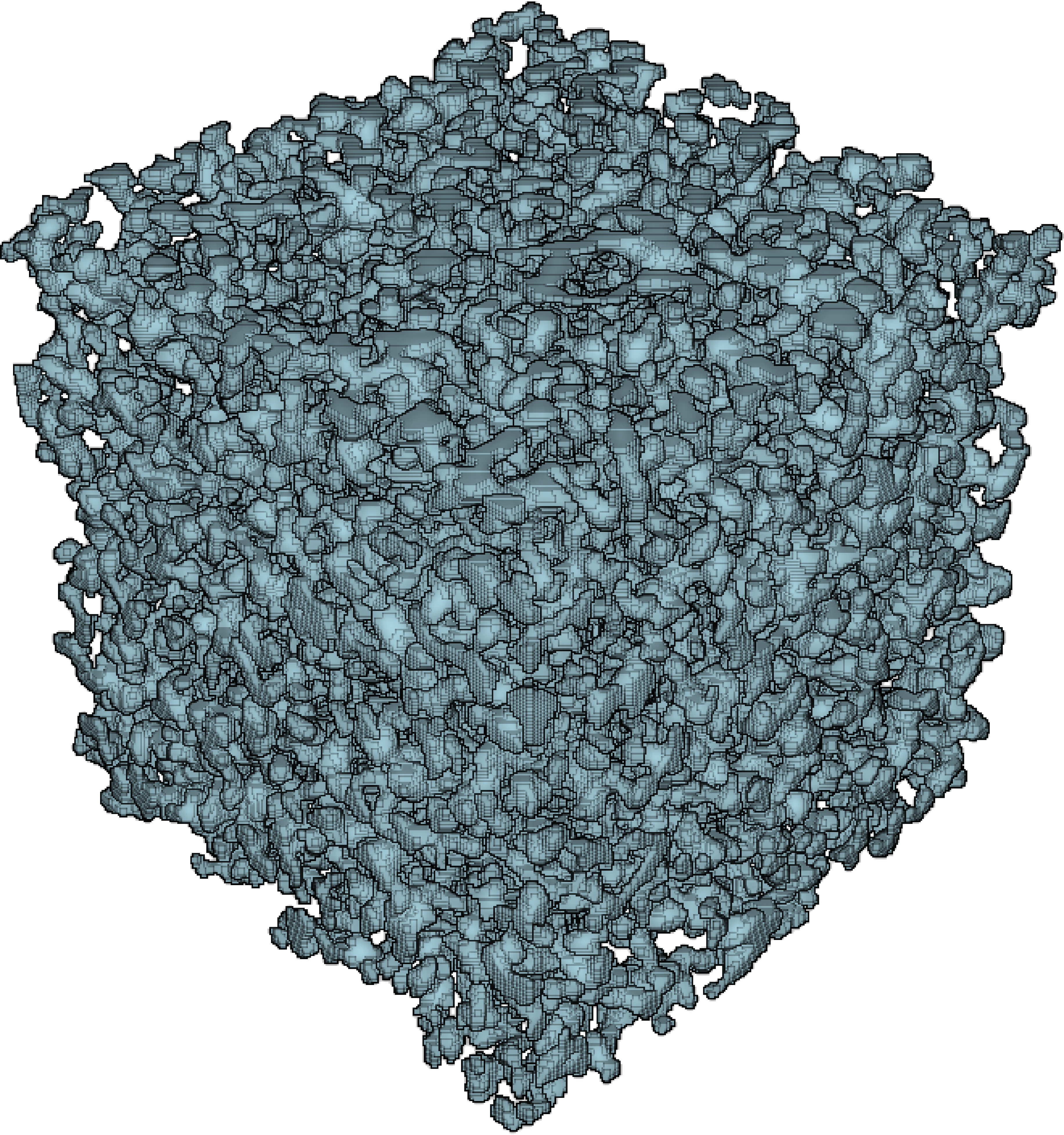
During the sintering of a pulverulent material, homogenization is a natural physico-chemical process that occurs as the system evolves toward a lower-energy state. Initially, the compact powder contains particles with different sizes, shapes, compositions, and packing arrangements. These heterogeneities create variations in surface energy and chemical potential throughout the material.
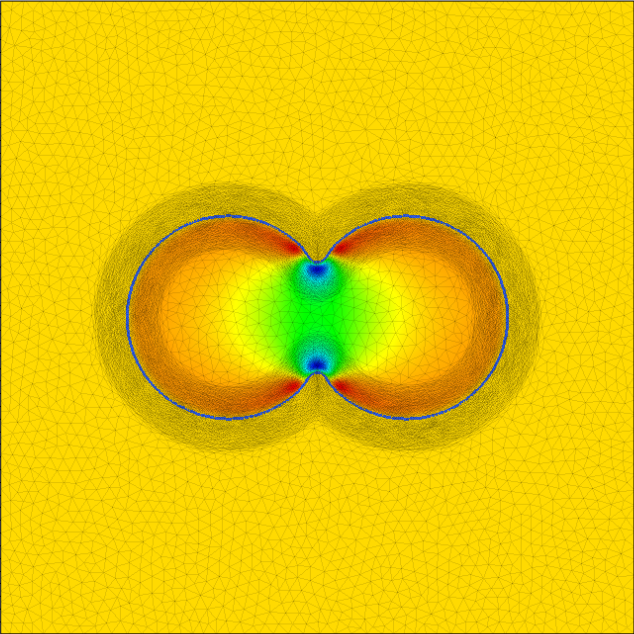
When the powder is heated up, particle diffusion becomes active. Chemical species migrate from regions of high chemical potential to regions of lower chemical potential, reducing concentration gradients and promoting chemical uniformity. Simultaneously, material is transported from particle surfaces toward contact points between particles, leading to the formation and growth of necks.
As sintering progresses, diffusion mechanisms such as surface diffusion, grain-boundary diffusion, and volume diffusion contribute to the redistribution of matter. Pores become smaller and more uniformly distributed, while density differences within the compact gradually decrease. Grain growth also helps reduce microstructural irregularities and contributes to a more homogeneous structure.
-
Total Sintering and Dense Ceramics
Fabrication of technical ceramics involves three matin steps: synthesis of powder, shaping and sintering. This last step is generally defined as a transformation of compacted powder into a solid with progressive removal of porosity using heat.
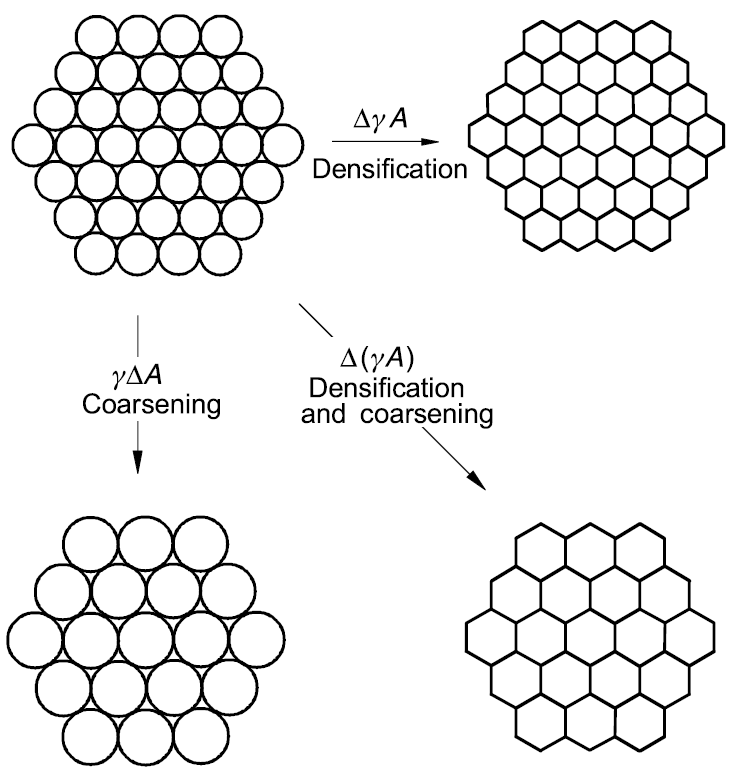
The driving force of sintering is the reduction of interfaces. It can occur by densification (replacement of solid/vapour interfaces by solid/solid interfaces) and by grain coarsening, as illustrated in the figure below. The formation of necks during solid state sintering is attributed to differences in the curvature of grains and necks. The latter is the driving force for mass transport. Movement of matter occurs by diffusion of species. Different paths of diffusion are possible ; some of them are considered as densifying diffusion mechanisms when they contribute to the densification of materials.
Different parameters related to the material and the process have an influence on the final density and microstructures of a sample. The parameters related to the material are chemical composition, powder’s characteristics (particle size, shape and size distribution). The parameters related to the process are temperature, heating and cooling rates, duration, atmosphere and presence of pressure.
Minimization of material, time and energy waste is mandatory in all production processes due to environmental concerns. To this aim, different non-conventional sintering processes have been developped and studied as an alternative to conventional sintering (i.e., sintering in a resistive furnace) to decrease the environmental impact of sintering.
-
Partial Sintering and Porous Ceramics
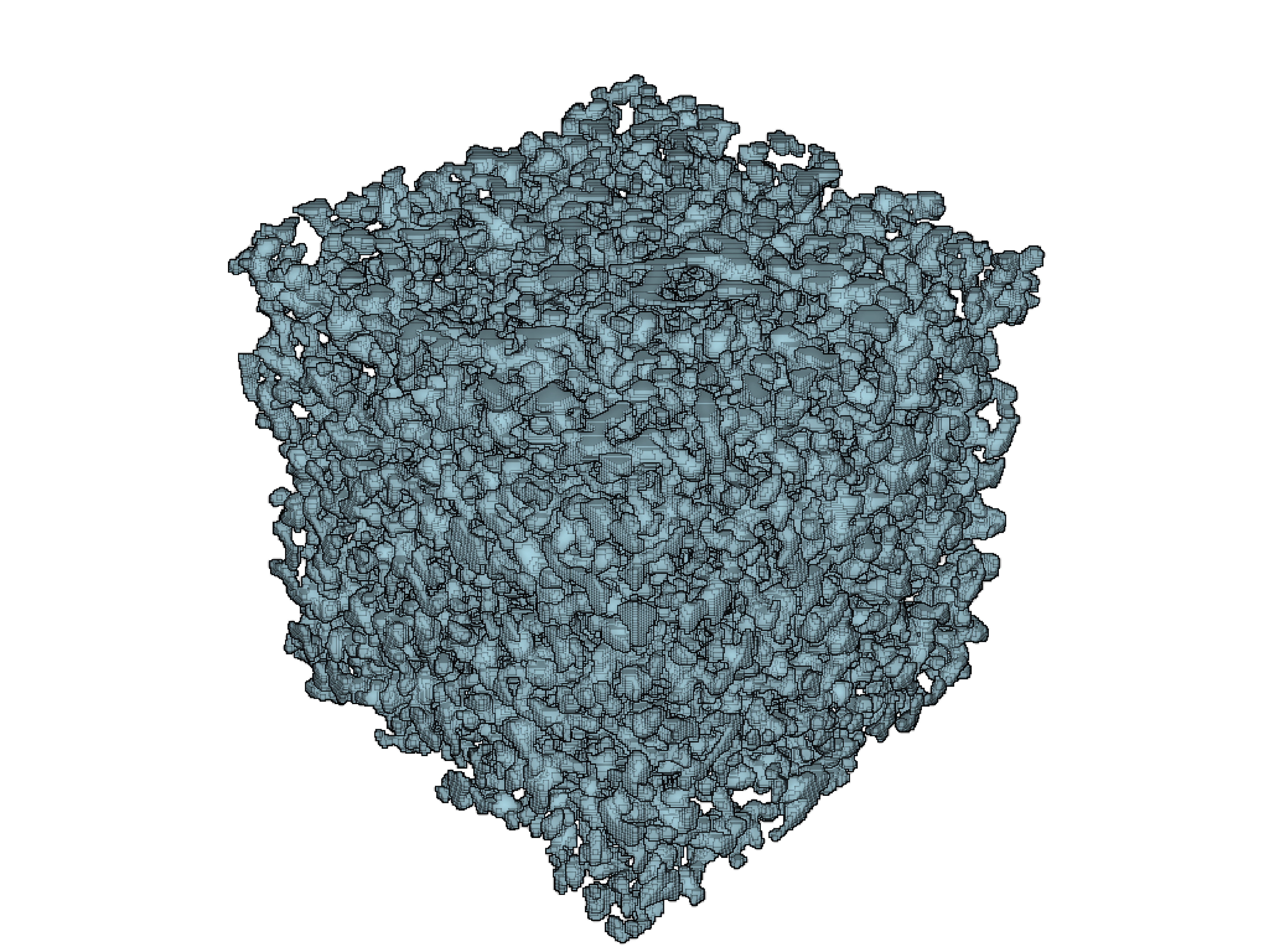
Sintering is a processing technique in which a pulverent material is heated to a temperature below its melting point. During this process, adjacent particles bond together through diffusion mechanisms, forming solid necks at their contact points. Unlike full sintering, partial sintering intentionally preserves a significant amount of porosity within the material structure.
This is one of the processes used to create porous ceramics. The size, shape, distribution, and connectivity of pores can be controlled by adjusting processing parameters such as sintering temperature, heating rate, holding time, and initial particle characteristics. Lower sintering temperatures and shorter dwell times generally lead to higher porosity levels.
Porous ceramics exhibit unique properties, including low density, high specific surface area, good thermal stability, and controlled permeability. These characteristics make them attractive for a wide range of industrial and biomedical applications. They are commonly used in filtration systems for gases and liquids, catalyst supports in chemical processing, thermal insulation components, and membrane technologies.
Mathematics
-
Mathematical Homogenization
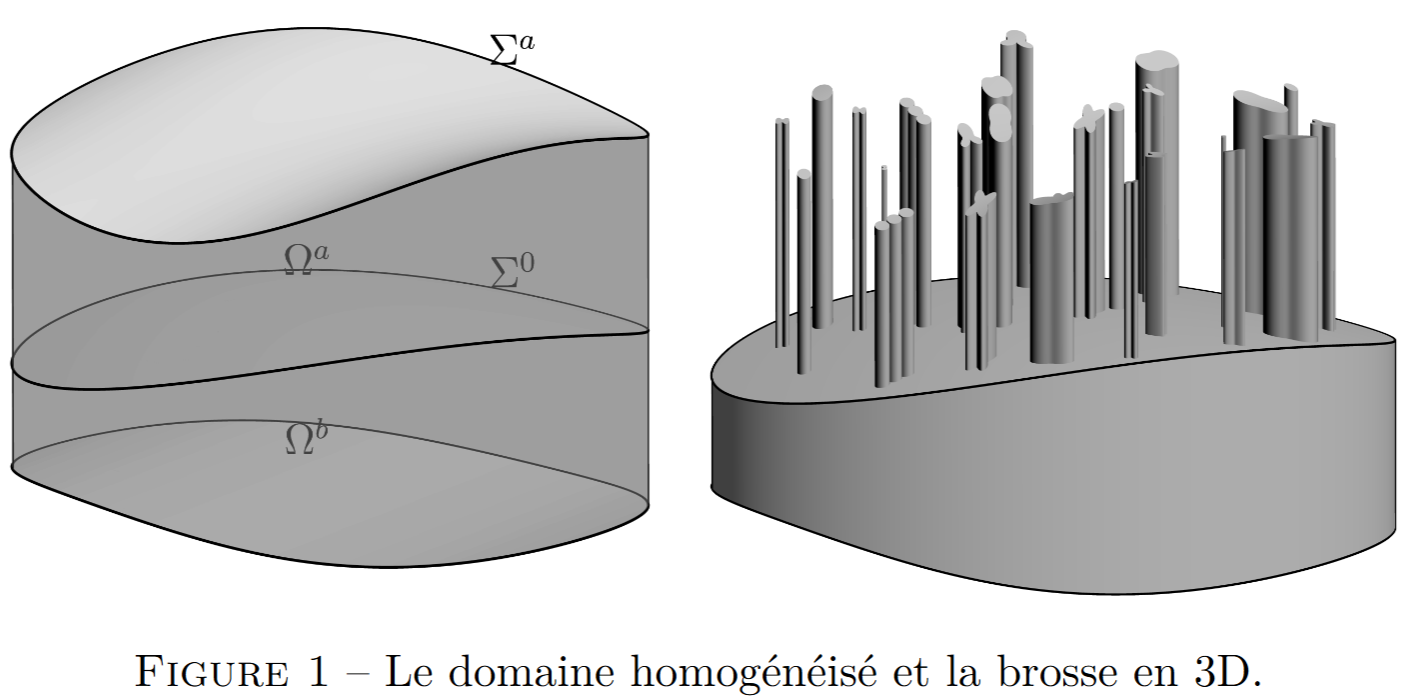
Numerous physical phenomenon happen within materials with a highly complex microstructure. For example composite materials with a high degree of mixing, materials with a ruguous surface or porous materials exhibiting a significant amount of microporosities.
In these materials, physical properties can vary widely in space. If one wants to model these phenomenons, they will obtain partial differential equations whose coefficients can vary a lot at small scale. Describing these highly varying coefficients can be an harduous or even impossible task.
The goal of homogenization theory is to understand the global behavior of these systems as the variations becomes small. The main idea relies on the fact that, despite the material being heterogeneous, it is much easier to model its global behavior using a simpler model.
In this limit model, called homogenized model, the material is replaced by an homogeneous one with equivalent macroscopic properties. This method aims at linking the microscopic properties to its macroscopic behavior and plays an important in the study of composite materials as well as porous media and many other physical phenomenon.
-
Random Tessellations
We consider uniformely distributed random points in the plane (also known as a Poisson Point Process).
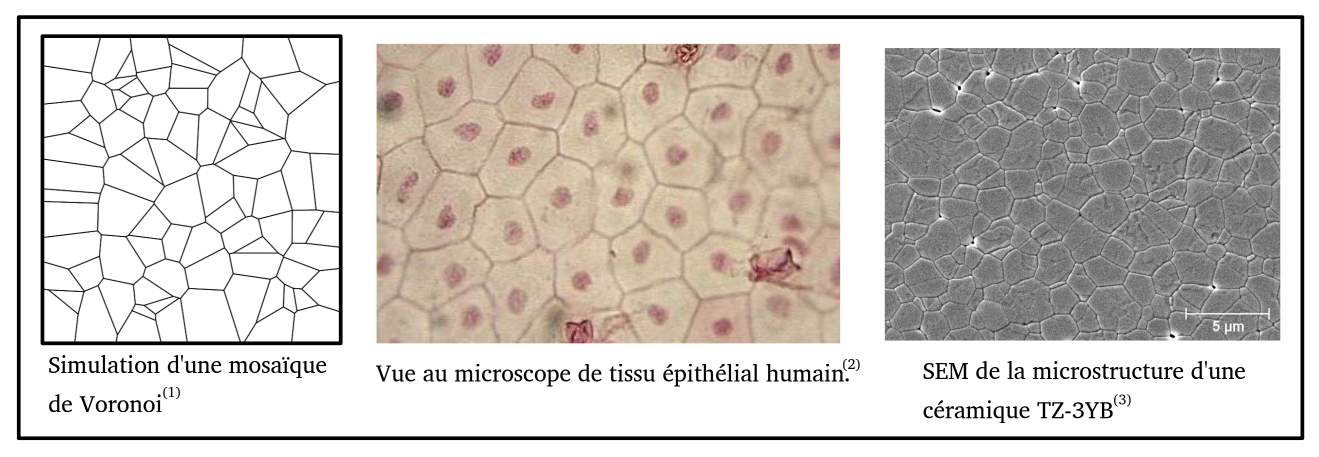
For each of these points, called germ, we define its Voronoi set as the points of the plane closest to it. The family of Voronoi sets obtained from the given germs constitutes a random tessellation of the plane called the Poisson-Voronoi tessellation.
Statistical properties of these random tessellations, such as the expected surface area of the cells, the expected number of vertices per cell, extreme values, etc. have extensively studied since the 20th century in the case of the euclidean plane but also in $R^n$ or even in more general spaces.
Poisson-Voronoi tessellations provide a wide range of applications from telecommunication (antennas positioning) to biology (studies of cells) or physics (crystallography, microstructure modeling).
-
Gaussian Random Fields
Gaussian Random Fields represent an important class of mathematical objects that have a wide range of applications such as texture generation, cosmology, the modelisation of random waves, astronomy or, in the case which interest us, the microstructure of cermaic materials.
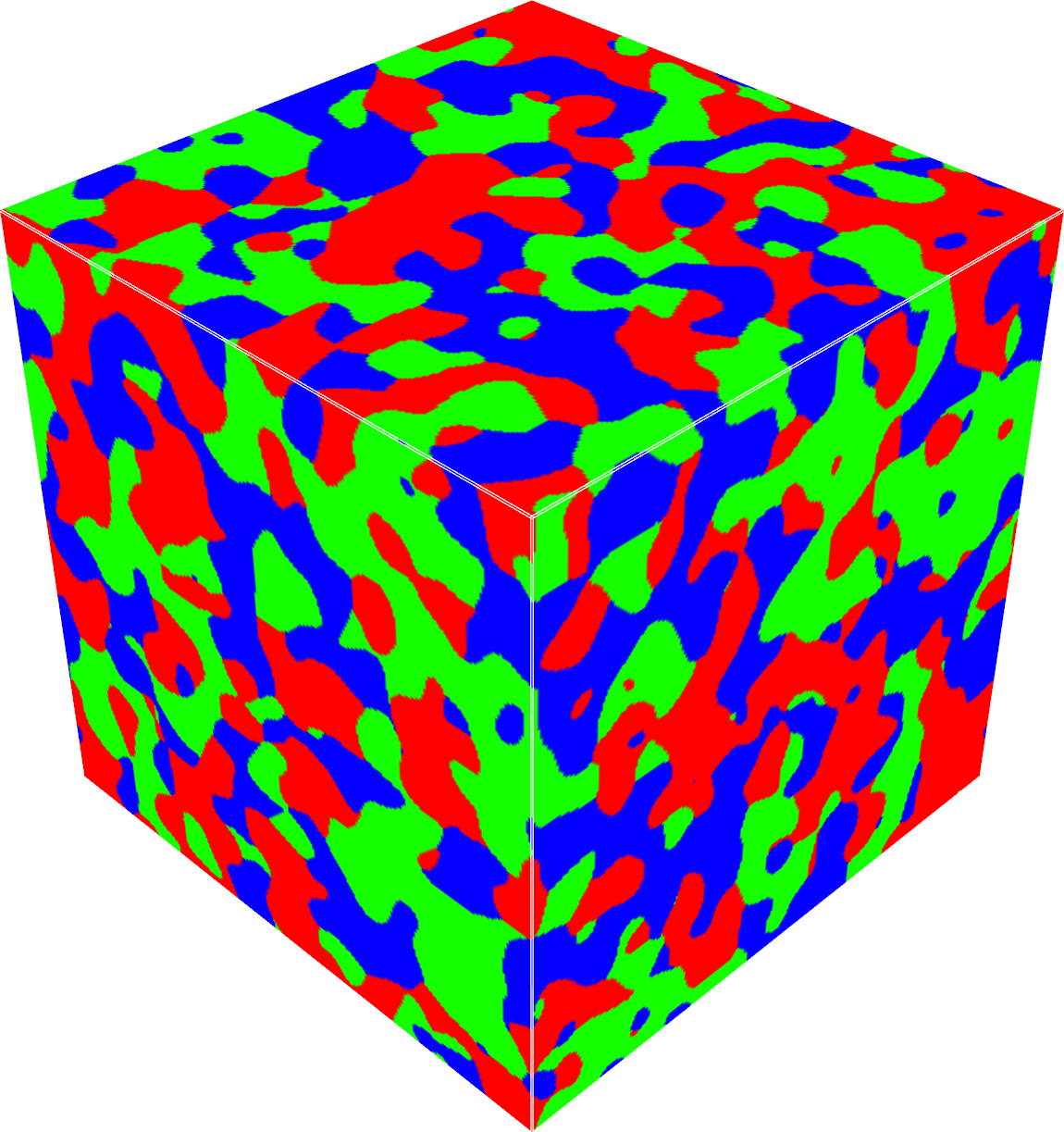
Indeed, the microstructure of partially sintered ceramic material can be quite accurately modeled by excursion sets of gaussian random fields for non-composite ceramics and by gaussian truncated field for composite ceramics as shown by the work of Lanzini et al. (2009) and Moussaoui et al. (2019).
With these models established, one can derive many properties of some geometric indicators from already known theoretical results as well as new ones. For example, the mean Lipschitz-Killing curvatures of the execursion sets (respectively the truncated sets) admit closed forms. Moreover these geometric indicator are closely related to physico-chemical quantities of interest for practitians.
Understanding the relationship between the theoretical results on gaussian random fields and the physical fields observed in sintered cermaics is therefore key in order to better control the way one can create those ceramic materials through numerical simulation instead of costly physico-chemical experiments. Obvioulsy other interresting links to different fields of physics and chemistry can be established.