Mathematical Models for the Microstructure of Ceramics

Europe/Paris
CERAMATHS, Département de Mathématiques (DMATHS)

CERAMATHS, Département de Mathématiques (DMATHS)

Université Polytechnique Hauts-de-France Campus Mont-Houy 59313, Aulnoy-lez-Valenciennes
Lucas Reding (Université Polytechnique Hauts-de-France, CERAMATHS), Matthias Täufer (Université Polytechnique Hauts-de-France)
Description

The conference Mathematical Models for the Microstructure of Ceramics  will be held on the 18 and 19 mai 2026 at the Université Polytechnique Hauts-de-France (UPHF), whitin CERAMATHS as a Focused Innovation Session of the COST Action C24122: mSPACE (multiscale Stochastics, Patterns, and Analysis of Combinatorial Environments) which will focus on the relationship between material sciences and mathematics.
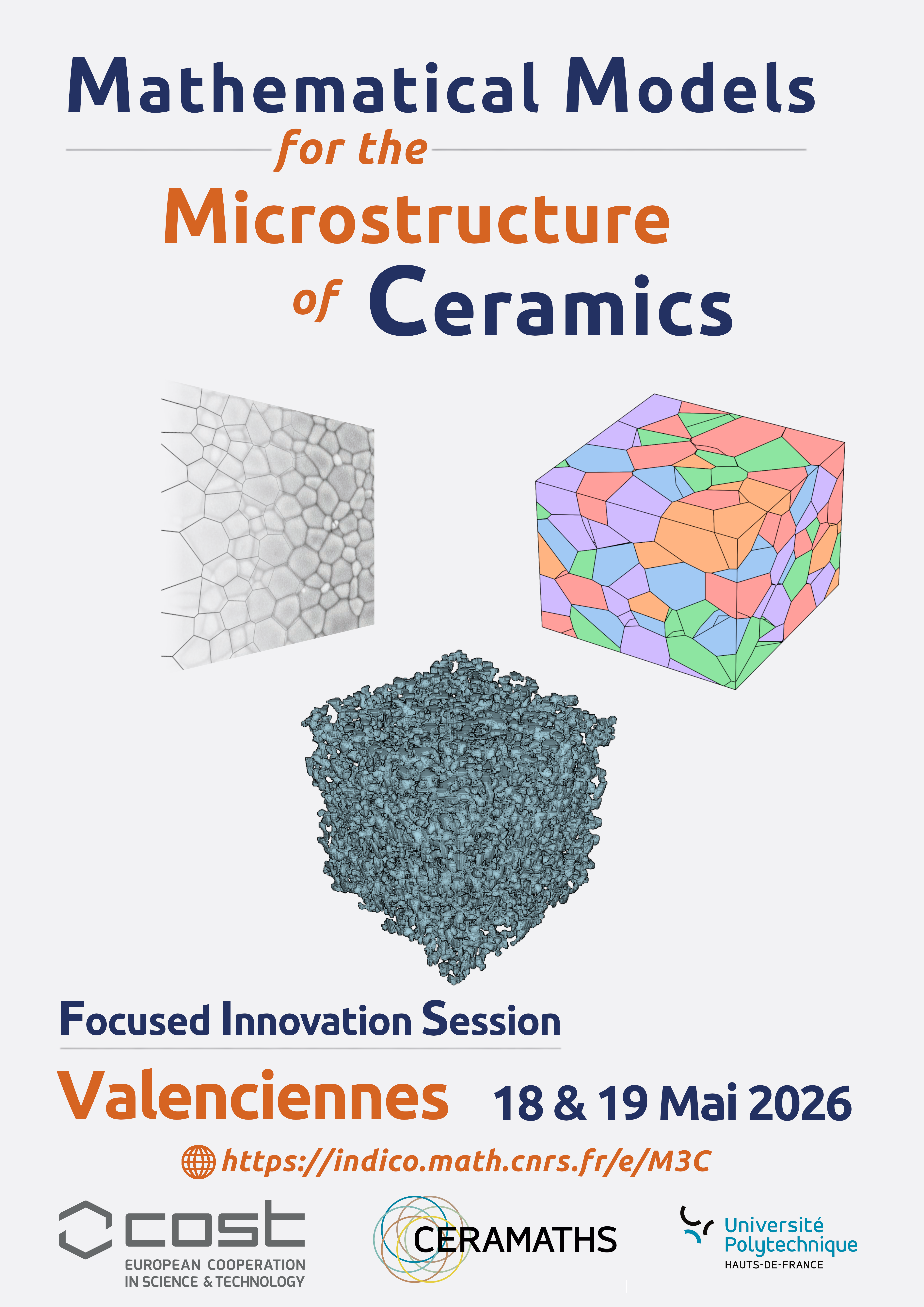
 

In particular, we will focus on the modeling of cermaic materials, both dense and porous. Numerous models will be presented by many experts from a theoritical but also a practical point of view.

Specialists from the field of mathematics as well as the field of material sciences will be present during this event.


    • 9:30 AM 10:00 AM
      Workshop Opening 30m
    • 10:00 AM 11:00 AM
      Processing of Ceramics by Powder Bed Laser Beam Melting 1h

      Powder Bed Selective Laser Processing (PBSLP) is a promising technique for the additive manufacturing of alumina. For the method’s success, PBSLP process parameters such as laser power, scanning speed, hatching distance, and scanning strategies need to be investigated. This paper focuses on studying the scanning strategies’ effects on the PBSLP of alumina numerically and experimentally. Scanning strategies such as linear with different orientation, concentric, and islands were investigated. A numerical model was developed in which the PBSLP
      parameters, scanning strategy effects, and interpreting the experimental results could be observed. The numerical model proved its ability to reach the proper process parameters instead of using experimental trails which are time and cost consuming. For relative density, the island
      strategy succeeded to print alumina samples with a high relative density reaching 87.8%. However, there are round passages formed inside the samples that remain a barrier for the island strategy to be effectively used in PBSLP of alumina. Both linear and concentric strategies
      achieved a relative density of 75% and 67%, respectively. Considering the top surface roughness, samples printed with linear strategies gave low top surface roughness compared to the island and concentric strategies. Linear-45◦is considered the most effective strategy among the studied strategies as it achieved good relative density and low roughness at top and side surfaces. For PBSLP of alumina, new scanning strategies should be considered, and this study presents a one that is mainly based on space filling mathematical curves that should be studied in future work.

      Speaker: Enrique Juste (Belgium Ceramic Reserach Center, CRIBC-INISMa)
    • 11:00 AM 12:00 PM
      Homogenization in Microstructured Domains 1h

      This talk is devoted to the homogenization of elliptic problems posed in microstructured domains. After a general introduction to homogenization, I will present a brush-type geometric setting, consisting of a fixed lower part and a vertically oscillating microstructure in the upper part. I will first consider a prototype elliptic problem of Laplace type, in order to highlight the influence of the fine geometry on the homogenized limit problem. In particular, I will show that the oscillating structure in the upper region leads, in the limit, to a transmission problem coupling a classical diffusion equation in the lower part with an effective degenerate vertical diffusion in the upper part. I will then briefly discuss an extension to a nonlinear monotone framework with a source term in ($L^1$), where the low regularity of the data leads naturally to the notion of renormalized solution. The aim of the talk is to show how microscopic geometric complexity may generate nontrivial effective macroscopic models.

      Speaker: Silvio Bove (Université de Paris 1 Panthéon-Sorbonne)
    • 12:00 PM 1:30 PM
      Lunch 1h 30m
    • 1:30 PM 2:00 PM
      Spectral theory of high-contrast random media 30m

      The talk is concerned with the rigorous mathematical description of propagation and localisation of waves in a particular class of composite materials with random microscopic geometry, called micro-resonant (or high-contrast) random media: small inclusions of a “soft" material are randomly dispersed in a “stiff" matrix. The highly contrasting physical properties of the two constituents, combined with a particular scaling of the inclusions, result in microscopic resonances, which manifest macroscopically by allowing propagation of waves in the material only within certain ranges of frequencies (band-gap spectrum).

      High-contrast media with periodically distributed inclusions have been extensively studied and numerous results are available in the literature. However, their stochastic counterparts, which model more realistic scenarios and may exhibit localisation, are far from being well understood from a mathematical viewpoint. In my talk I will give an overview of existing results through the prism of stochastic homogenisation and spectral theory, and discuss recent advances and ongoing work.

      Based on joint work with M. Cherdantsev, I. Velčić, P. Bella and M. Täufer.

      Speaker: Matteo Capoferri (University of Milan)
    • 2:00 PM 2:30 PM
      Inverse Homogenisation Problems for the Identification of Macroscopically Varying Microstructure Features 30m

      This talk is concerned with inverse homogenisation problems that
      aim to identify microstructure features of a body from macroscopic
      measurements. The unknown microstructure is assumed to vary macroscopically and affects the effective tensor in an elliptic partial differential equation that governs the behaviour of the body on the macroscale. We establish the well-posedness of the PDE-constrained minimization problems that model the task of identifying the microstructure, derive first-order necessary optimality conditions,
      and discuss a gradient-projection algorithm for the studied problem class in an infinite-dimensional setting. We moreover demonstrate that recently obtained results on generalized differentiability properties of
      solution maps of bilateral obstacle problems make it possible to set up
      and analyse a novel semismooth Newton method in the considered
      situation. The latter outperforms classical approaches drastically and
      opens up various directions for future research.

      Speaker: Constantin Christof
    • 2:30 PM 3:15 PM
      Work Session 45m
    • 3:15 PM 4:15 PM
      Direct Simulation of Matter Redistribution During Sintering in a Granular Packing 1h

      We propose a numerical framework to simulate the evolution of granular packings driven by surface and volume diffusion. Particle interfaces are captured using an Eulerian level-set approach, enabling a natural treatment of complex topological changes. Coupled with adaptive meshing and parallel computing, the method allows efficient large-scale simulations.

      Grains are modeled as elastic, and the resulting mechanical problem is solved using a stabilized finite element formulation to compute volume fluxes and interface motion.

      The framework is further extended to the sintering of heterogeneous packings composed of multiple grain populations (undoped and doped).

      Speaker: Julien Bruchon (Ecole des Mines de Saint-Etienne)
    • 4:15 PM 4:30 PM
      Break 15m
    • 4:30 PM 5:30 PM
      Work Session 1h
    • 7:30 PM 9:30 PM
      Conference Dinner 2h
    • 8:45 AM 9:00 AM
      Welcome 15m
    • 9:00 AM 10:00 AM
      Densification of ceramics and evolution of their microstructures during sintering 1h

      Fabrication of technical ceramics involves three matin steps: synthesis of powder, shaping and sintering. This last step is generally defined as a transformation of compacted powder into a solid with progressive removal of porosity using heat [1]. The driving force of sintering is the reduction of interfaces. It can occur by densification (replacement of solid/vapour interfaces by solid/solid interfaces) and by grain coarsening, as illustrated in Figure 1. The formation of necks during solid state sintering is attributed to differences in the curvature of grains and necks. The latter is the driving force for mass transport. Movement of matter occurs by diffusion of species. Different paths of diffusion are possible ; some of them are considered as densifying diffusion mechanisms when they contribute to the densification of materials.
      Different parameters related to the material and the process have an influence on the final density and microstructures of a sample. The parameters related to the material are chemical composition, powder’s characteristics (particle size, shape and size distribution). The parameters related to the process are temperature, heating and cooling rates, duration, atmosphere and presence of pressure. Minimization of material, time and energy waste is mandatory in all production processes due to environmental concerns. To this aim, different non-conventional sintering processes have been developped and studied as an alternative to conventional sintering (i.e., sintering in a resistive furnace) to decrease the environmental impact of sintering [2].
      This presentation will be divided in two main parts:
      • a general overview about sintering, densification and evolution of microstructures
      • a focus about some projects carried out in LGF about non-conventional sintering by microwave heating and sintering of recycled powders.

      Speaker: Clémence Petit (Ecole des Mines de Saint-Etienne)
    • 10:00 AM 11:00 AM
      Modeling for Sintering and 3D Printing: Main Approaches and New Needs for AI, Discrete-Continuum Approaches 1h
      Speaker: Charles Manière (CNRS, CRISMAT (Normandie Université))
    • 11:00 AM 11:15 AM
      Break 15m
    • 11:15 AM 12:15 PM
      Poisson Voronoi tessellations on Riemannian surfaces 1h

      In this talk we introduce the Poisson-Voronoi tessellation, a classical model of random mosaic based on seeds placed randomly in the plane, each associated with a Voronoi cell, consisting of all points of the plane closer to that seed than to any other. These cells can be seen as influence zones of the seeds.

      The statistical properties of these mosaics (average area, average number of vertices, extreme values, etc.) have been extensively studied since the 20th century, first in the plane and then in $R^n$, some examples of which we present.

      We then extend the model to a non-Euclidean framework, specifically on Riemannian surfaces, with a twofold aim : investigate properties of the tessellation and relate this to the geometrical characteristics of the surface, namely the Gaussian curvature.

      Speaker: Aurélie Chapron (Université de Rouen Normandie)
    • 12:15 PM 2:00 PM
      Lunch 1h 45m Restaurant Universitaire 2

      Restaurant Universitaire 2

      Université Polytechnique Hauts-de-France Campus Mont-Houy 59313, Aulnoy-lez-Valenciennes
    • 2:00 PM 3:00 PM
      Partial Sintering & Gaussian Fields Modeling 1h
      Speakers: Emilie Falourd (Ecole des Mines de Saint-Etienne), Lucas Reding (Université Polytechnique Hauts-de-France, CERAMATHS)
      • Total Sintering 30m
        Speaker: Lucas Reding (Université Polytechnique Hauts-de-France, CERAMATHS)
      • Gaussian Fields Modeling 30m
        Speaker: Mrs Emilie Falourd (Ecole des Mines de Saint-Etienne)
    • 3:00 PM 3:45 PM
      Work Session 45m
    • 3:45 PM 4:30 PM
      Work Session 45m
    • 4:30 PM 4:40 PM
      Workshop Closure 10m