
some students of ArpiLYSM2 fascinated by the Monge problem.

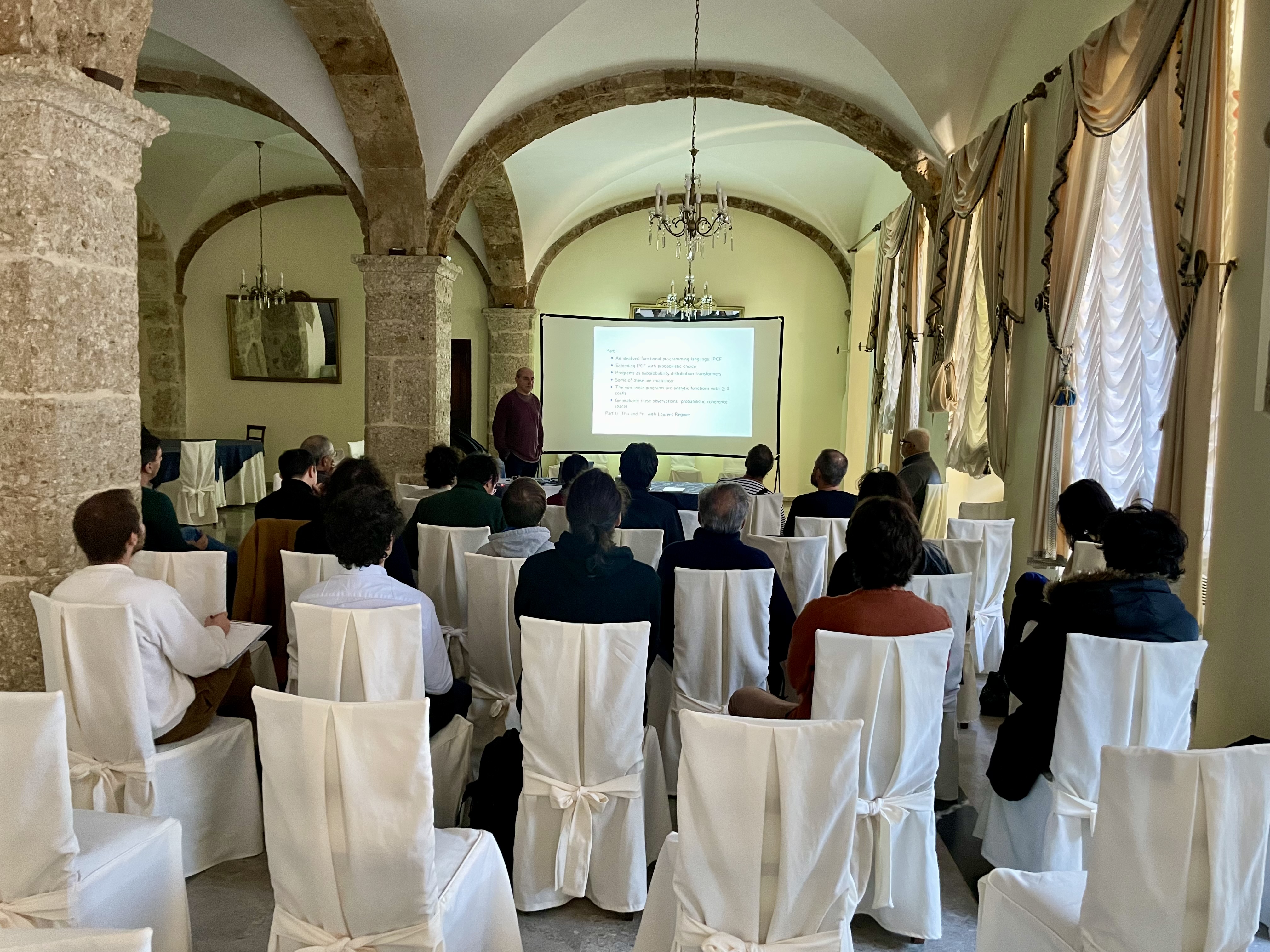
alumni opus optime the school at Arpino's acropolis
XXth century appears sometimes as mathematically non linear when one thinks to several achievements inherited from XIXth century like chaotic dynamics, non linear partial differential equations, non linear algebra to quote just a few. At the same time last century invented quantum mechanics as a linear necessary replacement of classical Newtonian dynamics, and linear logic as a refinement of classical and intuitionist logic.
Will XXIth century be linear or non linear? ArpiLYSM opens the debate.
The school will provide, among several seminars, three minicourses devoted to the different themes involved, in the title of the school, and will not necessitate any prerequisit other than elementary mathematics and physics knowledge . Wednesday will be concerned by the opposition linear versus non linear in other fields of mathematics and more, such as economy, art, and more general processes of thinking.
Thierry Paul, Stefano Rossi, Lorenzo Tortora de Falco, Lionel Vaux-Auclair, org.
Courses
-
Logic, by Thomas Ehrhard and Laurent Regnier
"Linearity and non-linearity in logic"
In logic, non-linearity is the possibility of using an arbitrary number of times an hypothesis. This may seem innocuous, but if one takes into account the Curry-Howard isomorphism between proofs and programs, an hypothesis is a resource and it becomes clear that non-linearity is a crucial ingredient of the algorithmic expressiveness of programs and proofs.
This essential role of non-linearity in logic has been made explicit by Jean-Yves Girard in the mid 1980's. The story started with the observation, in categorical models of intuitionistic logic, that the logical and the algebraic notions of (non-)linearity are very similar. This led to the introduction of Linear Logic which is not a "new logic" but a refinement of intuitionistic and of classical logic where the non-linear use of resources is made explicit. Thanks to this refinement various new concepts have been introduced in logic such as proof-nets, the geometry of interaction, logical differentiation etc.
This lecture will explain in which categorical situations Linear Logic appears and cover some of its conceptual outcomes.
-
Control, by Emmanuel Trélat
"Control theory: linear vs nonlinear aspects."
In this short course I will give an introduction to control theory, in finite and in infinite dimension, with a particular focus on linear and nonlinear aspects.
For linear systems, the theory is well established and controllability properties can be derived, by duality, by establishing observability inequalities.
For nonlinear systems, linearization (around some equilibrium or along a reference trajectory) is a powerful tool to establish local controllability properties. I will introduce several other approaches, such as the Coron return method, or the use of Lie brackets.
-
Quantum, by Thierry Paul
"The unreasonnable linearity of Quantum Mechanics and the beauty of the square root"
Quantum Mechanics is by essence linear. This unintuitive fact is essential for the understanding of the stability of the world, but also induces many surprising facts when comparing quantum structures with their classical counterpart, by essence non linear.
How can a non linear paradigm fit into a linear one without loosing its deep meaning? Square root, square root, square root.
In this short course we will show and link very different situations illustrating this pheomenon, like dynamical systems, optimal transport, Legendre transform and this fantastic transformer from non linear to linear which is the process of quantization and its relation with calculus of variation.