Choisissez le fuseau horaire
Le fuseau horaire de votre profil:
Les 1ères Journées Analyse des Séries Temporelles à Valenciennes du 23 au 24 juin 2025, à l'Université Polytechnique Hauts-de-France (UPHF), au sein du laboratoire CERAMATHS.
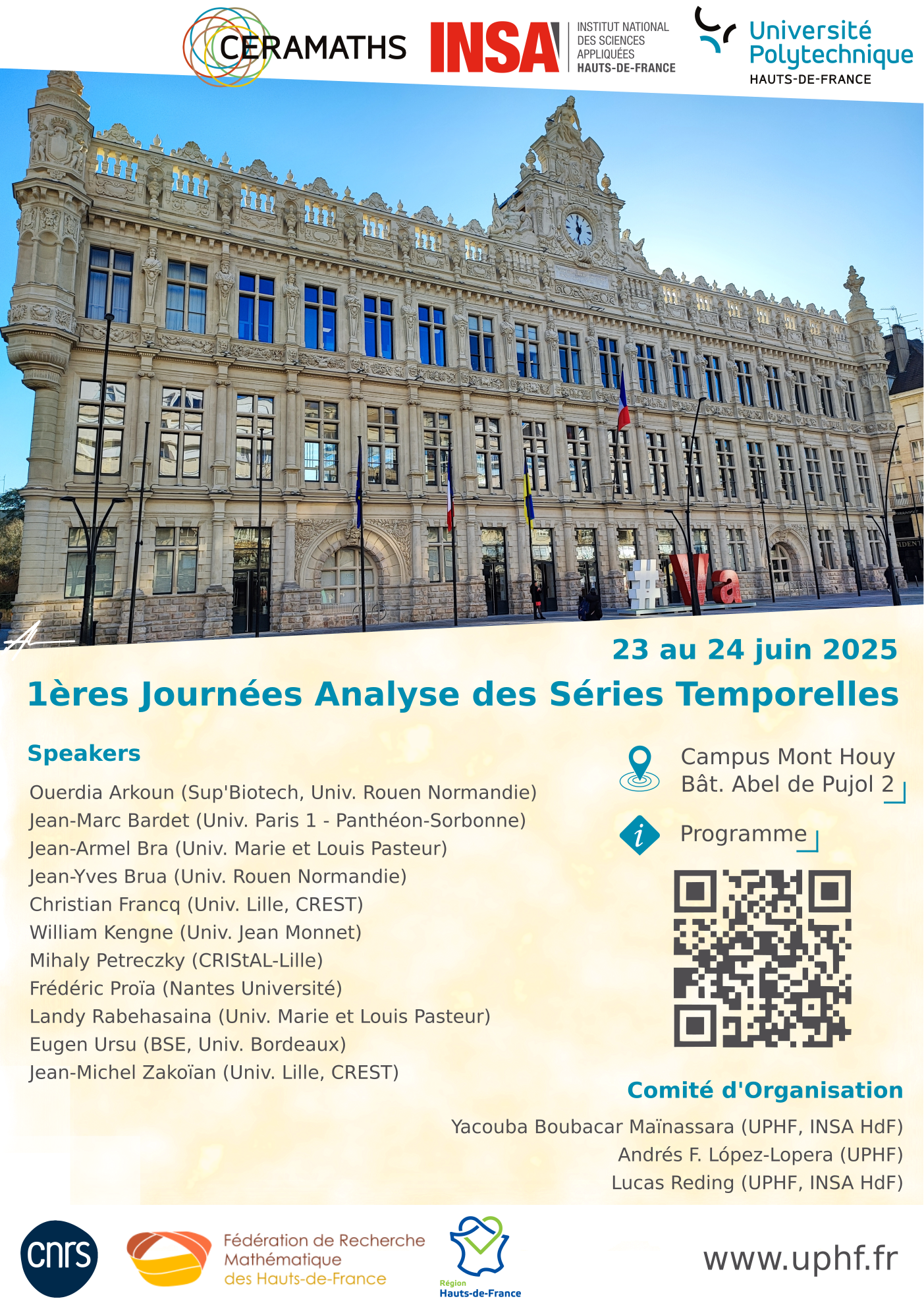
Le but de cette première édition du workshop est de développer, consolider et dynamiser un réseau entre Valenciennes et d'autres centres de recherche reconnus en France, sur l'analyse des séries temporelles ; en réunissant une dizaine de spécialistes (orateurs) pendant deux jours.
Ce workshop permettra d'une part d'augmenter la visibilité nationale de la recherche en statistique portée par le CERAMATHS et le rayonnement scientifique de ses travaux. D'autre part, il favorisera une recherche pluridisciplinaire qui implique les mathématiques, l'économétrie, la santé, les sciences de l'environnement.



We examine a linear regression model applied to the components of a time series, aiming to identify time-varying, constant as well as zero conditional beta coefficients. To address the non-identifiability of parameters when a conditional beta is constant, we employ a lasso-type estimator. This penalized estimator simplifies the model by shrinking the estimates in favor of natural constant beta representations. Given that the model accommodates conditional heteroskedasticity and the relevant regressors are unknown, the total number of parameters to estimate can be quite large. To manage this complexity, we propose a multistep estimator that first captures the dynamics of the regressors before estimating the dynamics of the betas. This strategy breaks down a high-dimensional optimization problem into several lower-dimensional ones. Since we avoid making strict parametric assumptions about the innovation distributions, we use Quasi-Maximum Likelihood (QML) estimators. The non-Markovian nature of the global model means that standard convex optimization results cannot be applied. Nevertheless, we analyze the asymptotic distribution of the multistep lasso estimator and its adaptive version, deriving bounds on the maximum value of the penalty term. We also propose a nonlinear coordinate-wise descent algorithm, which is demonstrated to find stationary points of the objective function. The finite-sample properties of these estimators are further explored through a Monte Carlo simulation and illustrated with an application to financial data.
Dans cet exposé, nous étudions le problème d’estimation non paramétrique d’une fonction dans un modèle autorégressif pour un risque quadratique. À cet effet, nous développons une méthode adaptative de sélection de modèles séquentielle basée sur les estimateurs séquentiels efficaces à noyaux proposés par Arkoun et Pergamenshchikov (2016). De plus, nous obtenons des inégalités d’oracle non asymptotiques pour le risque quadratique robuste.
Dans un second temps, nous proposons une méthode d’estimation adaptative efficace à l’aide de procédures robustes de sélection de modèle séquentielle. À cette fin, en utilisant l’inégalité de Van Trees pour ce modèle, nous obtenons la borne inférieure pour le risque robuste donnée sous la forme d’une constante de type Pinsker.
Ensuite, en utilisant la méthode des moindres carrés pondérés et les inégalités d’oracle non asymptotiques, nous développons un outil analytique permettant d’obtenir la propriété d’efficacité dans le sens minimax pour la procédure d’estimation proposée, c’est-à-dire que nous montrons que la borne supérieure de son risque coïncide avec la borne inférieure obtenue. Il convient de souligner que cette propriété est obtenue dans un cadre adaptatif où la régularité de la fonction d’auto-régression est inconnue.
On considère des processus autorégressifs pour lesquels on crée un pont entre un comportement stable et un comportement instable à l’aide d’une matrice compagne $A_n$ dépendant du temps et dont le rayon spectral$\rho(A_n) < 1$ est tel que $\rho(A_n) \to 1$. Ce cadre de travail est particulièrement pertinent pour comprendre les problématiques de racines unitaires en se focalisant sur la frontière intérieure du cercle unité. On étudie le comportement asymptotique de l’estimation en termes de consistance et de normalité. On propose de plus une procédure de test statistique pour décider de la proximité du rayon spectral avec le cercle unité, afin de savoir "à quel point un processus quasi-instable est proche de l’instabilité". Quelques résultats numériques illustrent ces résultats.
In this paper, we present the asymptotic properties of the moment estimator for autoregressive (AR for short) models subject to Markovian changes in regime under the assumption that the errors are uncorrelated but not necessarily independent. We relax the standard independence assumption on the innovation process to extend considerably the range of application of the Markov-switching AR models. We provide necessary conditions to prove the consistency and asymptotic normality of the moment estimator in a specific case. Particular attention is paid to the estimation of the asymptotic covariance matrix. Finally, some simulation studies and an application to the hourly meteorological data are presented to corroborate theoretical work.
The automotive industry is undergoing a major transformation driven by stringent regulations, particularly within the European Union (EU). The EU’s directive to ban the sale of combustion engine vehicles by 2035 is accelerating the shift towards electric and hybrid vehicles, reshaping the industry’s landscape. This regulation has a significant impact on the automotive industry, particularly in France, where more than 90% of new vehicles sold in 2018 were internal combustion engines. By examining the interplay between economic indicators and consumer preferences, the study aims to uncover the underlying dynamics driving the adoption of combustion, electric and hybrid engines. Using time series models like SARMAX-GARCH [1–3] or MS-ARX [4], the study examines the impact of both endogenous and exogenous variables on vehicle sales from 2010 to 2024. The results show that both internal and external variables affect passenger car registrations, with economic indicators having a different impact on each engine type.
Restaurant L'Escargot
46 bis Rue de Famars, 59300 Valenciennes
Based on Godambe’s theory of estimating functions, we propose a class of cumulative sum (CUSUM) statistics to detect breaks in the dynamics of time series under weak assumptions. First, we assume a parametric form for the conditional mean, but make no specific assumption about the data-generating process (DGP) or even about the other conditional moments. The CUSUM statistics we consider depend on a sequence of weights that influence their asymptotic accuracy. Data-driven procedures are proposed for the optimal choice of the sequence of weights, in the sense of Godambe. We also propose modified versions of the tests that allow to detect breaks in the dynamics even when the conditional mean is misspecified. Our results are illustrated using Monte Carlo experiments and real financial data.
We consider robust deep learning from strongly mixing observations, with unbounded loss function and unbounded input/output. It is only assumed that the output variable has a finite $r$ order moment, with $r > 1$. Non asymptotic bounds for the expected excess risk of the deep neural network estimator is established under subexponential strong mixing assumptions on the observations. We derive a relationship between these bounds and $r$, and when the data have moments of any order (that is $r=\infty$), the convergence rate is close to some well-known results. When the target predictor belongs to the class of Hölder smooth functions with sufficiently large smoothness index, the rate of the expected excess risk for subexponentially strongly mixing data is close to that obtained with i.i.d. samples. Application to robust nonparametric regression with heavy-tailed errors shows that, robust estimators with absolute loss and Huber loss outperform the least squares method
Auteur : Eugen Ursu
Affiliation : BSE, Université de Bordeaux.
Résumé : Periodic autoregressive (PAR) models extend the classical autoregressive models by allowing the parameters to vary with seasons. Selecting PAR time-series models can be computationally expensive, and the results are not always satisfactory. In this presentation, we propose an automatic procedure for identifying PAR models and multiregime PAR models. We aim at filling the literature gap on multiple changepoint detection by allowing several time segments to be detected, inside of which a different PAR structure is specified, with the resulting model being employed to successfully capture the discontinuities of river flow data. The model estimation is performed by optimization of an objective function based on an information criterion using genetic algorithms. The proposed methodology is evaluated by means of simulation studies and it is then employed in the analysis of several river flows : the Fraser river measured at Hope, British Columbia, the South Saskatchewan, measured at Saskatoon, Canada, and the Colorado, measured at Lees Ferry, Arizona. For these river flows we build changepoint models, discussing the possible events that caused discontinuity, and evaluate their forecasting accuracy. Comparisons with the literature on river flow analysis and on existing methods for changepoint detection confirm the efficiency of our proposal.
Rendez-de-vous au RU
Consider the trajectory of a time series with time-varying coefficients. The aim of this talk is to test the adequacy of these parameters at a finite and fixed number of instants of the trajectory. For this purpose, a Wald test is constructed from point estimates of the parameters obtained by minimization of a kernel contrast. This can take the form of a localized near-maximum likelihood estimator for ARMA or GARCH processes, or a localized least squares estimator for a GLARCH process, but many other time-varying time series such as AR($\infty$), ARCH($\infty$), ARMA-GARCH, APARCH,..., could be considered. Above all, this allows the introduction of a new stationarity test for these processes, whose very good numerical performance has been demonstrated by numerical experiments.
In this talk I will talk about non-asymptotic PAC-like theoretical guarantees for learning dynamical systems. For the sake of simplicity, we will concentrate on linear and linear-parameter varying systems. We will mainly consider systems in discrete-time with stochastic noise, and then we will discuss some extension of these results to continuous-time systems. Learning linear (parameter-varying) systems is an established topic in control theory, more precisely in the subfield of control theory known as system identification. However, most of the established results deal with asymptotic guarantees for learning, i.e., they show statistical consistency of the learning algorithms. In contrast, there are relatively few results providing finite-sample bounds on the estimation error and generlisation error of the learned models. In particular, there are almost no results on probably approximately correct (PAC) and PAC-Bayesian bounds on the generalisation gap for dynamical systems. This is especially the case for stochastic systems which are learned from a single time-series. This problem is challenging for several reasons : the data is not i.i.d, the models use an increasing number of data points to generate predictions, the signals involved need not be bounded. The motivation for studying PAC(-Bayesian) bounds is as follows. First, such bounds could be useful for LQG reinforcement learning. Second, as recurrent neural networks (RNN) contain linear systems as a special case, PAC-Bayesian bounds for linear systems could be useful as a first step for deriving similar bounds for RNNs. In turn, PAC-Bayesian bounds turned out to be promising for deriving non-trivial generalisation bounds for neural networks.
In this talk I will present recent results on PAC-Bayesian bounds for linear stochastic systems in discrete-time learned from a single time series. I will then mention recent extensions to non-linear systems. I will also discuss extensions to continuous-time systems learned from i.i.d. data.
We consider an observed subcritical Galton Watson process $\{Y_n, n \in \mathbb{Z}\}$ with correlated stationary immigration process $\{\epsilon_n, n \in \mathbb{Z}\}$. Two situations are presented. The first one is when $cov(\epsilon_0, \epsilon_k) = 0$ for $k$ larger than some $k_0$ : a consistent estimator for the reproduction and mean immigration rates is given, and a central limit theorem is proved. The second one is when $\{\epsilon_n, n \in \mathbb{Z}\}$ has general correlation structure : under mixing assumptions, we exhibit an estimator for the the logarithm of the reproduction rate and we prove that it converges in quadratic mean with explicit speed. In addition, when the mixing coefficients decrease fast enough, we provide and prove a two terms expansion for the estimator. Numerical illustrations are provided.