Workshop on Frugality and Explainability (Toulouse)

→ Europe/Paris
Amphithéâtre Schwartz - 1R3 (Campus Rangueil)

Amphithéâtre Schwartz - 1R3

Campus Rangueil

118 Route de Narbonne 31000 Toulouse
Chloe Braud (IRIT - UT - CNRS), Jose Moreno (Université de Toulouse), Josiane Mothe (Univ. Toulouse)
Description

Virtual attendance: https://visio.numerique.gouv.fr/upj-ftut-uev 
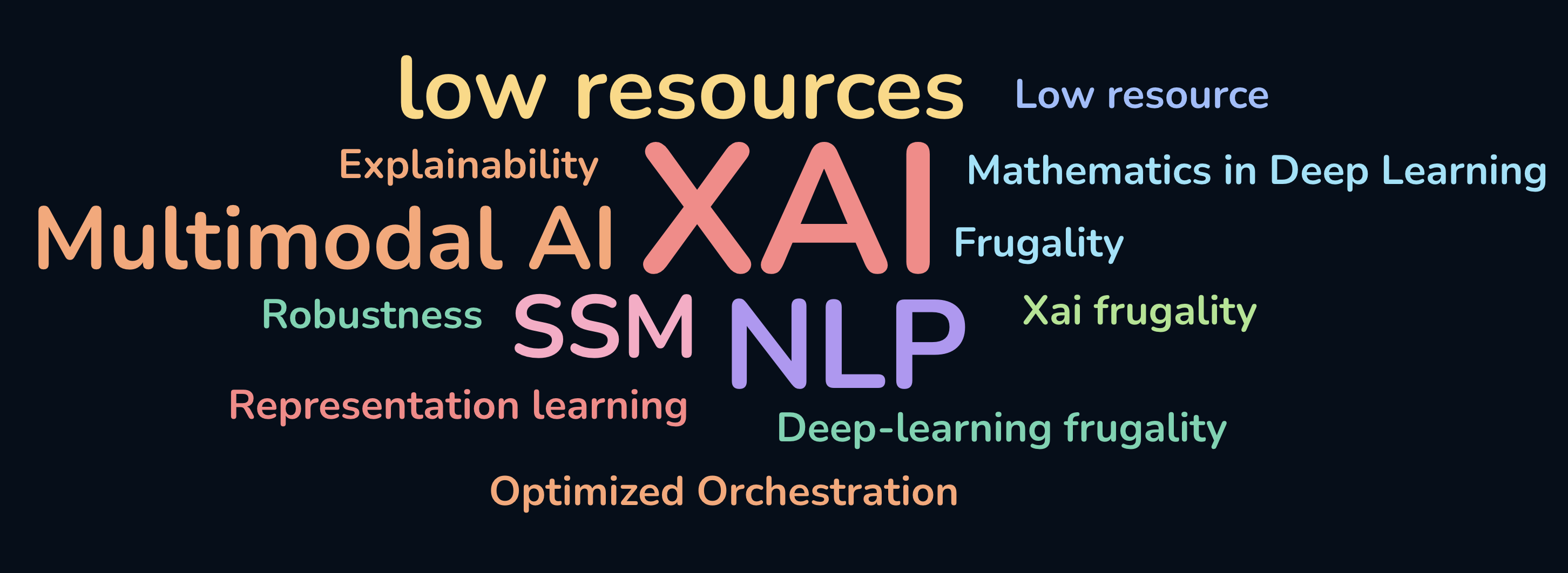
This workshop is part of the CIMI 2026 thematic trimester on “Low-Resource Settings in AI”. The goal of this trimester is to deepen our understanding of AI models—particularly pre-trained neural models such as language, vision, and multimodal models—under conditions of severe data or computational constraints.

During this workshop, we will focus in particular on models and systems developed with computational frugality constraints, as well as on issues of model explainability for text and images.

The workshop will feature presentations by international guests and researchers from Toulouse, as well as tutorials. The full program will be available soon on the website, but we are pleased to confirm the participation of our distinguished guests:

  • Alexandre Allauzen, Professor at ESPCI (Paris, France)
  • Lihu Chen, Research Associate at Imperial College London (London, UK)
  • Constances Douwes, Associate Professor at Centrale Méditerranée  (Marseille, France).
  • Didier Schwab, Professor at University Grenoble Alpes (Grenoble, France)
  • Adil Zouitine, Founding Research Scientist at UMA (Paris, France)


The workshop will also feature 3 tutorials:


Participation in the workshop is free, but registration is required so that we can better assess our organizational needs.


Important dates: 

  • September, 3: Deadline for student grant application
  • September, 10: Deadline for registration and presentation proposals
  • October 6-9: Workshop - University of Toulouse campus
CIMI26 Organizers
    • 12:45
      Welcome Coffee Amphithéâtre Schwartz - 1R3

      Amphithéâtre Schwartz - 1R3

      Campus Rangueil

      118 Route de Narbonne 31000 Toulouse
    • Opening Remarks Amphithéâtre Schwartz - 1R1 (campus Rangueil)

      Amphithéâtre Schwartz - 1R1

      campus Rangueil

      Présidents de session: Mme Chloe Braud (IRIT - UT - CNRS), Jose G Moreno (Université de Toulouse), Josiane Mothe (Univ. Toulouse)
    • 1
      Invited Talk: Adil Zouitine - Efficient Vision-Language-Action Model Amphithéâtre Schwartz - 1R1 (campus Rangueil)

      Amphithéâtre Schwartz - 1R1

      campus Rangueil

      Title: Efficient Vision-Language-Action Model

      Abstract: The talk asks how to make general-purpose robot policies usable without industrial-scale data or GPUs. Its answer is that low-resource robotics means choosing carefully where every parameter, demonstration and millisecond goes. It starts from first principles: a VLA is a policy that reads camera images, an instruction and the robot state, and outputs a short chunk of continuous actions. It is built from Transformer attention and a vision-language model. Our research, SmolVLA, pairs a compact pretrained VLM with a small flow-matching action expert. The result is a model about seven times smaller than π0 that is pretrained on community robot data. The talk then argues that the runtime is part of the policy. Asynchronous inference and real-time chunking keep the robot moving smoothly while the next action chunk is being computed. It closes on a next step, which is to learn how actions change the world (world-action models) without making the robot wait.

      Bio: Adil Zouitine is a founding research scientist at UMA, where he works on general-purpose mobile and humanoid robots capable of learning in real time. He holds a PhD in robust reinforcement learning, supervised by Emmanuel Rachelson. His research focuses on robustness to disturbances, sample efficiency, generalization, and adversarial reinforcement learning.
      After completing his PhD, Adil joined Hugging Face, where he helped build LeRobot, an open-source library for robot learning. He is also an active contributor to several open-source projects, including River, the online machine learning counterpart to scikit-learn.

      Orateur: M. Adil Zouitine (UMA)
    • 2
      Invited Talk: Constance Douwes - Energy and environmental impacts of deep learning Amphithéâtre Schwartz - 1R3

      Amphithéâtre Schwartz - 1R3

      Campus Rangueil

      118 Route de Narbonne 31000 Toulouse

      Title: Energy and environmental impacts of deep learning

      Abstract: In recent years, artificial intelligence based on deep learning models has become increasingly widespread across a wide range of applications, achieving ever-greater performance with ever-increasing computational cost. This growth drives higher energy consumption and carbon emissions, running counter the emission reduction pathways recommended by the IPCC. In this presentation, I will present and explore the environmental impacts associated with developing, training, and deploying deep learning models using the life-cycle assessment methodology. I aim to provide useful methods for estimating the impacts and to raise awareness of the environmental challenges posed by the rapid growth of AI, thereby encouraging more efficient and responsible practices.

      Bio: Constance Douwes is associate professor in computer science at Centrale Méditerranée in Marseille (France). She's specialized in the environmental footprint of modern AI with a particular interest for deep learning audio models.

      Orateur: Mme Constance Douwes (Centrale Méditerranée)
    • 16:00
      Coffee Break Amphithéâtre Schwartz - 1R3

      Amphithéâtre Schwartz - 1R3

      Campus Rangueil

      118 Route de Narbonne 31000 Toulouse
    • Tutorial: Adil Zouitine - Efficient RL, interleaving training and policy interaction Amphithéâtre Schwartz - 1R1 (campus Rangueil)

      Amphithéâtre Schwartz - 1R1

      campus Rangueil

      Tutorial 1 : Adil Zouitine - Efficient RL, interleaving training and policy interaction

      The tutorial builds from MDPs to Soft Actor-Critic with TorchRL and TensorDict, then to an asynchronous, SERL-style system with Ray. Its main idea is that efficiency has three meanings: samples, compute and wall-clock time. SAC is off-policy, so collecting data with the current policy and training on replayed data can run in parallel instead of taking turns. A simple budget, the update-to-data ratio, sets how many gradient updates each new transition earns. Rollout workers keep acting while a learner trains, and fresh policy weights are sent back periodically. This improves wall-clock efficiency, not sample efficiency by itself, and it costs a small amount of policy staleness that the system measures and bounds.

      Tutorial 2 : Ronan Sicre, Hajar Dekdegue and Moncef Garouani: Explainable AI (XAI) and visual recognition models

      The practical session will allow you to delve into some standard explanations such as gradCAM.

      Tutorial 3: Antonin Poché - Language models explainability

      Through a tutorial, we will apply the methods notably with a bias detection use case.

    • 3
      Invited Talk: Alexandre Allauzen - Towards Frugal Deep Learning: Alternative to backprop, Data Sketching, and Causal Attention Amphithéâtre Schwartz - 1R1 (campus Rangueil)

      Amphithéâtre Schwartz - 1R1

      campus Rangueil

      Title: Towards Frugal Deep Learning: Alternative to backprop, Data Sketching, and Causal Attention

      Abstract: This talk presents recent research conducted by the MILES team, within the framework of the PEPR SHARP project, toward the development of frugal deep learning. As contemporary AI systems continue to grow in scale, computational cost, and energy consumption, there is a need for learning paradigms that are more efficient and sustainable. Our work explores this challenge from three complementary perspectives: (i) learning algorithms that can approximate gradient-based optimization while maintaining strong learning capabilities; (ii) on the way to data efficiency, we explore dynamical sketching to summarize and organize data during the learning process; (iii) trading complexity for expressivity in the design of attention mecanism for causal decoding.

      Bio: Since November 2019, Alexandre Allauzen has been Professor at
      ESPCI Paris (École Supérieure de Physique et de Chimie Industrielles de la Ville de Paris). He is affiliated with LAMSADE (Laboratoire d’Analyse et de Modélisation de Systèmes pour l’Aide à la Décision) at Université Paris-Dauphine and leads the MILES (Machine Intelligence and Learning Systems) research team. His work focuses on frugal deep learning and its applications to speech processing and natural language processing. More recently, his research has expanded to machine learning for the sciences,
      with a particular emphasis on physics, in collaboration with the Institut Langevin (Smart-Waves program). Since September 2025, he has also served as Vice-President for Academic Affairs and Training at Université Paris Sciences et Lettres (PSL), where he contributes to the institution’s academic strategy and educational development.

      Orateur: M. Alexandre Allauzen (ESPCI Paris - LAMSADE)
    • 10:00
      Coffee Break Amphithéâtre Schwartz - 1R3

      Amphithéâtre Schwartz - 1R3

      Campus Rangueil

      118 Route de Narbonne 31000 Toulouse
    • 4
      Léopold Maytié - Learning Universal Multimodal Representations via a Global Workspace with Minimal Paired Data Amphithéâtre Schwartz - 1R3

      Amphithéâtre Schwartz - 1R3

      Campus Rangueil

      118 Route de Narbonne 31000 Toulouse

      Title: Learning Universal Multimodal Representations via a Global Workspace with Minimal Paired Data

      Abstract: Learning multimodal representation using current deep learning methods requires a massive amount of multimodal paired data, relying on pure supervised learning. These paired data are difficult to obtain, limiting the possible amount available or requiring a lot of works to create them. On the opposite humans and animals in general are able to learn useful multimodal representation using only few paired samples. Recent works have begun tackling this challenge by reducing reliance on full supervision and dense pairing, yet limitations remain.
      This work builds on these efforts, adapting the Global Workspace Theory of human cognition to multimodal representation learning under limited supervision. Central to this theory, the broadcasting mechanism, implemented with a set of modality-specific encoders and decoders, enables training through unsupervised and self-supervised losses using cycle-consistency.
      We evaluated our approach on retrieval, generation, and latent space arithmetic tasks across varying amounts of paired samples. Our method outperformed current state-of-the-art approaches in very low paired data regimes and scaled more effectively as the amount of paired data increased.

      Bio: Léopold Maytié received the Ph.D. degree in computer science from the University of Toulouse, France, in 2025, with a thesis on multimodal representation learning for robotics. He is currently a postdoctoral researcher at the University of Innsbruck, Austria, where he works on latent representations for reinforcement learning, with a focus on discovering diverse strategies to solve a same problem. His research interests include representation learning and world models for planning and problem solving.

    • 5
      Laure Vieu - Environmental impacts: where is our responsibility? Amphithéâtre Schwartz - 1R3

      Amphithéâtre Schwartz - 1R3

      Campus Rangueil

      118 Route de Narbonne 31000 Toulouse

      Title: Environmental impacts: where is our responsibility?

      Abstract : In this talk, after briefly reviewing the environmental impacts of the AI industry at large, I'll point out that the urgently needed frugality goes beyond designing small models with low cost and consumption. Our responsibility as scientists also lie in controlling the uses of our results to achieve sufficiency. This means avoiding rebound effects and misuses, and even envisioning the transformational effects on society and assessing their desirability. That's hard! I'll propose to tackle this as a collective action.

      Bio: Laure Vieu is Directrice de Recherche at CNRS, in the IRIT lab. Her
      career developed at the interface between formal ontology in knowledge
      representation (symbolic AI) and formal semantics and pragmatics in
      linguistics. Since 2020, she is involved in the collective efforts of
      the French research community towards reducing the research
      environmental footprint and is leading the "ecological transition
      initiative" at IRIT.

    • 11:30
      Lunch - Esplanade Amphithéâtre Schwartz - 1R3

      Amphithéâtre Schwartz - 1R3

      Campus Rangueil

      118 Route de Narbonne 31000 Toulouse
    • 6
      Mathieu Serrurier - Is Trustworthy AI Compatible with Frugality in Machine Learning? Amphithéâtre Schwartz - 1R3

      Amphithéâtre Schwartz - 1R3

      Campus Rangueil

      118 Route de Narbonne 31000 Toulouse

      Title: s Trustworthy AI Compatible with Frugality in Machine Learning?

      Abstract: This presentation focuses on adversarial robustness in critical systems and its compatibility with frugality. We will examine the benefits, as well as the theoretical and practical limitations, of current adversarial robustness guarantees. Furthermore, we will explore how these guarantees interact with other desirable properties of trustworthy AI, such as explainability, privacy, and calibration, while highlighting their limitations in low-data regimes.

      Bio:

    • 7
      Invited Talk: Ronan Sicre, Moncef Garouani and Hajar Dekdegue Amphithéâtre Schwartz - 1R1 (campus Rangueil)

      Amphithéâtre Schwartz - 1R1

      campus Rangueil

      Title: Explainable AI (XAI) and visual recognition models

      Abstract: First, a one hour presentation will provide details on the various types of explanations methods, pros and cons. XAI include two main types of methods: post-hoc or passive and transparency or active. Posthoc methods aims at explaining an already trained mode, while active methods aims at rendering the model more transparent or explainable by design. Another set of method focus on Concepts that can be active or passive and that provide more understandable features in their explanations.

      Then a short presentation on some works held at IRIT, such as Fusion-CAM, and a demo on evaluating the discriminativity of Class Activation Maps (CAMs) across CNN architectures, layers, and target classes in multi-label classification, and their faithfulness to the model’s decision-making process.

      Finally a 1:30 practical session will allow you to delve into some standard explanations such as gradCAM.

      Bio:
      Moncef Garouani is an Associate Professor of Computer Science at Université Toulouse Capitole and a researcher at IRIT. His research interests lie at the intersection of Machine Learning, Explainable Artificial Intelligence (XAI), multimodal learning, and Responsible AI. His work focuses on developing transparent, trustworthy, and human-centered AI systems, with particular emphasis on explainability, automated machine learning, multimodal data analysis, and the responsible design, governance, and deployment of AI.

      Ronan Sicre is junior professor at University of Toulouse and IRIT since 2025, after being assistant professor for 8 years at Ecole Centrale Méditerranée and LIS. He add prior postdoc positions at INRIA Rennes, University of Caen, University of Amsterdam and obtain his PhD from the University of Bordeaux. He works in the field of deep learning, computer vision and explainable AI.

      Hajar Dekdegue, PhD student at IRIT, Université de Toulouse.

      Orateurs: Mme Hajar Dekdegue (UT - IRIT), M. Moncef Garouani (Université Toulouse Capitole - IRIT), M. Ronan Sicre (University of Toulouse - IRIT)
    • 15:30
      Coffee Break Amphithéâtre Schwartz - 1R3

      Amphithéâtre Schwartz - 1R3

      Campus Rangueil

      118 Route de Narbonne 31000 Toulouse
    • Tutorial: Ronan Sicre and Moncef Garouani - Explainability for vision models Amphithéâtre Schwartz - 1R3

      Amphithéâtre Schwartz - 1R3

      Campus Rangueil

      118 Route de Narbonne 31000 Toulouse

      Tutorial 1 : Adil Zouitine - Efficient RL, interleaving training and policy interaction

      The tutorial builds from MDPs to Soft Actor-Critic with TorchRL and TensorDict, then to an asynchronous, SERL-style system with Ray. Its main idea is that efficiency has three meanings: samples, compute and wall-clock time. SAC is off-policy, so collecting data with the current policy and training on replayed data can run in parallel instead of taking turns. A simple budget, the update-to-data ratio, sets how many gradient updates each new transition earns. Rollout workers keep acting while a learner trains, and fresh policy weights are sent back periodically. This improves wall-clock efficiency, not sample efficiency by itself, and it costs a small amount of policy staleness that the system measures and bounds.

      Tutorial 2 : Ronan Sicre, Hajar Dekdegue and Moncef Garouani: Explainable AI (XAI) and visual recognition models

      The practical session will allow you to delve into some standard explanations such as gradCAM.

      Tutorial 3: Antonin Poché - Language models explainability

      Through a tutorial, we will apply the methods notably with a bias detection use case.

    • 8
      Clovis Varangot-Reille - LLM Routing: Selecting the Cheapest Capable LLM for Every Query Amphithéâtre Schwartz - 1R3

      Amphithéâtre Schwartz - 1R3

      Campus Rangueil

      118 Route de Narbonne 31000 Toulouse

      Title: LLM Routing: Selecting the Cheapest Capable LLM for Every Query

      Abstract: Most LLM-based applications route every query to a single generalist model, typically a very large one, so that quality holds across all incoming queries. In practice, many of those queries are simple enough that a much cheaper model would answer them just as well. LLM routing reframes model choice as a per-query decision, sending each query to the cheapest model able to handle it. Routing can be framed as maximizing the quality of answers while minimizing inference costs. This raises challenges in real systems that we will review. Two of these challenges make router implementation difficult: the router must generalize to a rapidly evolving pool of LLMs, and it must not consume the resources it is meant to save. We focus on retrieval-based routers, a strong and low-resource baseline that meets both constraints: the routing decision reduces to a nearest-neighbour aggregation, and adapting to a new model pool means updating a corpus rather than retraining a router. We also present an efficient implementation in streaming settings.

      Bio: AI Research Engineer @ Wikit & PhD CIFRE Student @ Laboratoire Hubert Curien, Université Jean Monnet

    • 9
      Grégoire Dhimoïla - Cross-Modal Redundancy and the Geometry of Vision–Language Embeddings Amphithéâtre Schwartz - 1R3

      Amphithéâtre Schwartz - 1R3

      Campus Rangueil

      118 Route de Narbonne 31000 Toulouse

      Title: Cross-Modal Redundancy and the Geometry of Vision–Language Embeddings

      Abstract: Vision–language models (VLMs) align images and text with remarkable success, yet the geometry of their shared embedding space remains poorly understood. To probe this geometry, we begin from the Iso-Energy Assumption, which exploits cross-modal redundancy: a concept that is truly shared should exhibit the same average energy across modalities. We operationalize this assumption with an Aligned Sparse Autoencoder (SAE) that encourages energy consistency during training while preserving reconstruction. We find that this inductive bias changes the SAE solution without harming reconstruction, giving us a representation that serves as a tool for geometric analysis. Sanity checks on controlled data with known ground truth confirm that alignment improves when Iso-Energy holds and remains neutral when it does not. Applied to foundational VLMs, our framework reveals a clear structure with practical consequences: (i) sparse bimodal atoms carry the entire \crossmodal alignment signal; (ii) unimodal atoms act as \modalityspecific biases and fully explain the modality gap; (iii) removing \unimodal atoms collapses the gap without harming performance; (iv) restricting vector arithmetic to the \bimodal subspace yields in-distribution edits and improved retrieval. These findings suggest that the right inductive bias can both preserve model fidelity and render the latent geometry interpretable and actionable.

      Bio: Grégoire Dhimoïla, PhD student at IMT. Research on concept based interpretability and state space models for vision.

    • 10:30
      Coffee Break Amphithéâtre Schwartz - 1R3

      Amphithéâtre Schwartz - 1R3

      Campus Rangueil

      118 Route de Narbonne 31000 Toulouse
    • Session Poster Amphithéâtre Schwartz - 1R3

      Amphithéâtre Schwartz - 1R3

      Campus Rangueil

      118 Route de Narbonne 31000 Toulouse

      Poster session :

      • Briag Rehel (PhD, IRIT, Liebherr) - RAG Optimisation - RAGO au challenge RAG d'EvalLLM202
      • Robin Pujol (PhD, IRIT - UT) - Interpretable-by-design image classification models
      • Noé Mastrorillo (Master, IRIT - UT) - Creation of a constrained synthetic textual database for training and evaluating small language models.
      • Hugo Carlesso (PhD, IRIT - CNRS) - Curriculum Multi-Task Self-Supervision Improves Lightweight Architectures for Onboard Satellite Hyperspectral Image Segmentation
      • Hajar Dekdegue (PhD, IRIT)
      • Md Aftab Uddin (PhD, UTBM - FEMTO-ST)
      • Emilie Durrieu (PhD, ENAC - IRIT) - Object-Level Explanations for Image Geolocation Models: a GeoGuessr use-case
      • Omar Naïm
      • Krish Sharma
      • Arthur Chiron et Thomas Labreur - How far can a small encoder carry cell identity from nuclear morphology? (with few labeled data)
      • Grégoire Dhimoïla (IMT) - Cross-Modal Redundancy and the Geometry of Vision–Language Embeddings
      • Cristina Garcia Holgado (University of Corsica & University of Poitiers)
      • Robin Davenne
      • Diane Orhan (Postdoc, IRIT): Monitoring: ’just in case’ must become ’just enough’.
      • Jan Bellingrath (PhD, CERCO - IRIT)
      • Josiane Mothe (Pr, IRIT - UT)
    • 12:00
      Lunch - Esplanade Amphithéâtre Schwartz - 1R3

      Amphithéâtre Schwartz - 1R3

      Campus Rangueil

      118 Route de Narbonne 31000 Toulouse
    • 10
      Invited Talk: Antonin Poché - Language models explainability Amphithéâtre Schwartz - 1R1 (campus Rangueil)

      Amphithéâtre Schwartz - 1R1

      campus Rangueil

      Title: Language models explainability

      Summary: We will examine the specificity of language in explainability for both classification and generation. Study how explainability methods are adapted to text and what the state of the art currently is. Finally, through a tutorial, we will apply the methods seen in theory, notably with a bias detection use case.

      Bio: Antonin is a 2nd-year PhD Student in the Explainability of Language Models, between the IRT Saint Exupéry and the IRIT. He has been working on explainability for the last 5 years and is part of the developing teams of the Xplique and Interpreto explainability libraries.

      Orateur: M. Antonin Poché (IRT Saint Exupéry - IRIT)
    • Tutorial: Antonin Poché - Explainability for language models Amphithéâtre Schwartz - 1R1 (campus Rangueil)

      Amphithéâtre Schwartz - 1R1

      campus Rangueil

      Tutorial 1 : Adil Zouitine - Efficient RL, interleaving training and policy interaction

      The tutorial builds from MDPs to Soft Actor-Critic with TorchRL and TensorDict, then to an asynchronous, SERL-style system with Ray. Its main idea is that efficiency has three meanings: samples, compute and wall-clock time. SAC is off-policy, so collecting data with the current policy and training on replayed data can run in parallel instead of taking turns. A simple budget, the update-to-data ratio, sets how many gradient updates each new transition earns. Rollout workers keep acting while a learner trains, and fresh policy weights are sent back periodically. This improves wall-clock efficiency, not sample efficiency by itself, and it costs a small amount of policy staleness that the system measures and bounds.

      Tutorial 2 : Ronan Sicre, Hajar Dekdegue and Moncef Garouani: Explainable AI (XAI) and visual recognition models

      The practical session will allow you to delve into some standard explanations such as gradCAM.

      Tutorial 3: Antonin Poché - Language models explainability

      Through a tutorial, we will apply the methods notably with a bias detection use case.

    • 16:00
      Coffee Break Amphithéâtre Schwartz - 1R3

      Amphithéâtre Schwartz - 1R3

      Campus Rangueil

      118 Route de Narbonne 31000 Toulouse
    • Tutorial: Antonin Poché - Explainability Amphithéâtre Schwartz - 1R1 (campus Rangueil)

      Amphithéâtre Schwartz - 1R1

      campus Rangueil

      Tutorial 1 : Adil Zouitine - Efficient RL, interleaving training and policy interaction

      The tutorial builds from MDPs to Soft Actor-Critic with TorchRL and TensorDict, then to an asynchronous, SERL-style system with Ray. Its main idea is that efficiency has three meanings: samples, compute and wall-clock time. SAC is off-policy, so collecting data with the current policy and training on replayed data can run in parallel instead of taking turns. A simple budget, the update-to-data ratio, sets how many gradient updates each new transition earns. Rollout workers keep acting while a learner trains, and fresh policy weights are sent back periodically. This improves wall-clock efficiency, not sample efficiency by itself, and it costs a small amount of policy staleness that the system measures and bounds.

      Tutorial 2 : Ronan Sicre, Hajar Dekdegue and Moncef Garouani: Explainable AI (XAI) and visual recognition models

      The practical session will allow you to delve into some standard explanations such as gradCAM.

      Tutorial 3: Antonin Poché - Language models explainability

      Through a tutorial, we will apply the methods notably with a bias detection use case.

    • 18:00
      Cocktail Amphithéâtre Schwartz - 1R3

      Amphithéâtre Schwartz - 1R3

      Campus Rangueil

      118 Route de Narbonne 31000 Toulouse
    • 11
      Invited Talk: Didier Schwab - Saisir l’IA générative avec justesse : RAG pour une IA plus frugale, souveraine et maîtrisée Amphithéâtre Schwartz - 1R1 (campus Rangueil)

      Amphithéâtre Schwartz - 1R1

      campus Rangueil

      Title: Saisir l’IA générative avec justesse : RAG pour une IA plus frugale, souveraine et maîtrisée

      Abstract: Les systèmes d'IA générative sont souvent associés à des modèles toujours plus grands et plus coûteux. Pourtant, dans de nombreux contextes professionnels, la performance ne passe pas nécessairement par l'augmentation de la taille du modèle.
      Cette présentation s'appuie sur les travaux de la chaire de recherche, d’innovation et de formation AugmentIA (Fondation Grenoble INP, Artelia, MIAI Grenoble Alpes), consacrée à l'IA générative pour l'ingénierie : eau, énergie, mobilité, construction. Elle explorera plusieurs voies vers une IA plus frugale et mieux maîtrisée : spécialisation des modèles, valorisation du patrimoine documentaire et recherche d'information sur des données réelles.
      Nous nous intéresserons en particulier à la génération augmentée par la recherche (Retrieval-Augmented Generation, RAG). Elle consiste à retrouver dans les documents de l'entreprise les informations pertinentes et à les fournir au modèle au moment où elles sont nécessaires. En dissociant les capacités générales du modèle des connaissances du domaine, cette approche permet de recourir à des modèles plus petits, dont la pertinence repose sur le contexte fourni plutôt que sur leur taille. Elle renforce aussi la maîtrise du système. Les réponses peuvent s'appuyer sur des sources citées, et les connaissances se mettent à jour sans réentraînement. Des modèles de taille raisonnable peuvent en outre être hébergés sur une infrastructure souveraine, sans que les données quittent l’organisation.
      Faire mieux avec moins, c'est finalement ne pas chercher le modèle le plus puissant, mais construire le système le plus simple capable de répondre au besoin.

      Bio: Didier Schwab est professeur en informatique à l’Université Grenoble Alpes, spécialiste du traitement automatique des langues et de l’intelligence artificielle. Il dirige l’équipe GETALP du Laboratoire d’Informatique de Grenoble (LIG) et la formation au sein du MIAI Cluster Grenoble Alpes. Il est également titulaire de la chaire de recherche AugmentIA, consacrée au développement d’une IA générative plus frugale, souveraine et adaptée aux besoins des entreprises. Ses travaux portent notamment sur les modèles de langue, l’IA multimodale, l’accessibilité et l’adaptation des modèles aux domaines spécialisés.

      Orateur: M. Didier Schwab (UGA - LIG)
    • 10:30
      Coffee Break Amphithéâtre Schwartz - 1R3

      Amphithéâtre Schwartz - 1R3

      Campus Rangueil

      118 Route de Narbonne 31000 Toulouse
    • 12
      Invited Talk: Lihu Chen - Knowledge Boundary Awareness in Large Language Models Amphithéâtre Schwartz - 1R1 (campus Rangueil)

      Amphithéâtre Schwartz - 1R1

      campus Rangueil

      Title: Knowledge Boundary Awareness in Large Language Models

      Abstract: Large language models (LLMs) possess remarkable knowledge and reasoning capabilities, yet their capabilities are bounded. A fundamental challenge for trustworthy and efficient AI is enabling models to identify the limits of their own knowledge before producing an answer. In this talk, I will present our recent work on knowledge boundary awareness, a generation-free framework for estimating whether an LLM can answer a query. I will then discuss how knowledge boundary awareness helps build more efficient AI systems by reducing inference cost while maintaining the original performance.

      Bio: Lihu Chen is a Research Associate at Imperial College London. He received his Ph.D. from Télécom Paris (Institut Polytechnique de Paris) and previously held a postdoctoral position at Inria Saclay. His research focuses on natural language processing and large language models, with interests in trustworthy and efficient AI, information extraction, and biomedical NLP. He develops open-source models and tools to improve the reliability and efficiency of AI systems.

      Orateur: Lihu Chen
    • Closing Remarks Amphithéâtre Schwartz - 1R1 (campus Rangueil)

      Amphithéâtre Schwartz - 1R1

      campus Rangueil

      Présidents de session: Mme Chloe Braud (IRIT - UT - CNRS), Jose G Moreno (Université de Toulouse), Josiane Mothe (Univ. Toulouse)