Des plasmas (Vlasov-Poisson) aux bancs de poissons : quarante-trois ans à dépasser les limites

→ Europe/Paris
Amphi L. Schwartz (bât 1R3) (Université de Toulouse)

Amphi L. Schwartz (bât 1R3)

Université de Toulouse

IMT, Université de Toulouse, 118, route de Narbonne, 31062 Toulouse cedex
Francis Filbet (Université Paul Sabatier, Toulouse III)
Description

Journées autour de la théorie cinétique et la modélisation mathématiques....

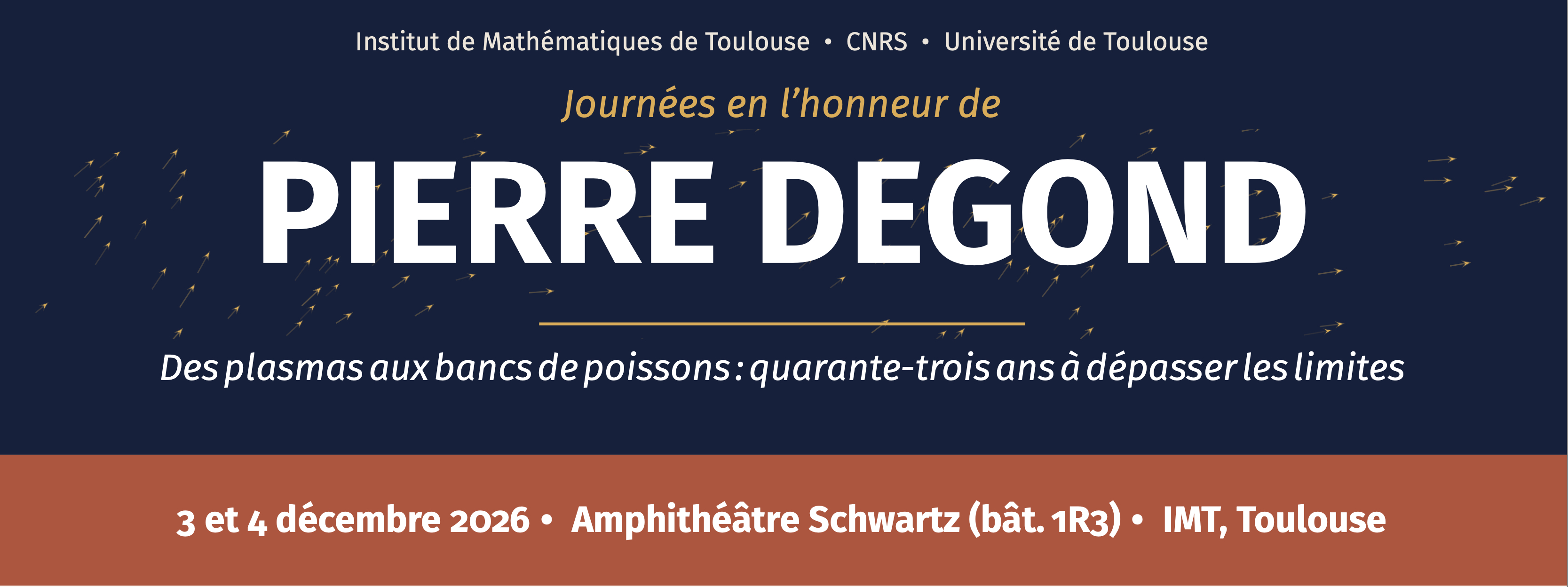
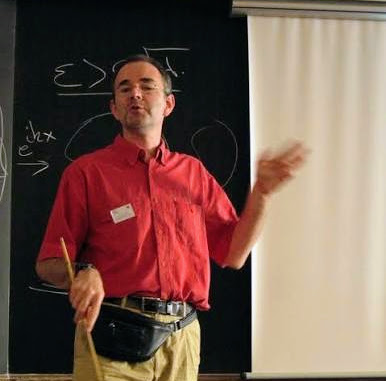
  Les 3 et 4 décembre 2026, l'Institut de Mathématiques de Toulouse organise deux demi-journées en l'honneur de Pierre Degond. Ses anciens étudiants, post-doctorants,  collaborateurs et amis viendront y présenter leurs travaux.


Des équations de Fokker–Planck–Landau aux modèles d’auto-organisation du vivant, en passant par les semi- conducteurs et l’hydrodynamique quantique : plus de quatre décennies durant, Pierre Degond a fait de la théorie cinétique un langage commun à la physique, à la biologie et aux  sciences sociales.


Les journées se dérouleront au sein de l'IMT (amphithéâtre L. Schwartz, sur le campus Université Paul Sabatier, Bât 1R3)

Contact : Francis FILBET
Inscription
Inscription aux journées des 3 et 4 décembre 2026
    • 1
      Talk 3
      Orateur: Mme Sara Merino Aceituno
    • 2
      Talk 2
      Orateur: Mlle Diane Peurichard
    • 15:30
      Break
    • 3
      Talk 1
      Orateur: Mme Sophie Hecht
    • 4
      Talk 4
      Orateur: M. Luc Mieussens
    • 5
      Des groupes de poissons, des crochets de Poisson, et des représentations de groupes de Lie… Comment en est-on arrivés là ?

      Dans cet exposé, je vais essayer, en retraçant presque vingt ans d’interactions avec tout un groupe de mathématicien·nes, de prouver que Pierre est un pur mathématicien, produisant tant de variété (fibrée), sur des modèles bien concrets !

      L’exposé n’est pas parfaitement encore dimensionné (probablement qu’il y aura du n⩾4), mais on y parlera en vrac de modèles d’alignement ; sur des variétés Riemanniennes, d’autres basés sur le contrôle de la courbure des trajectoires, et d’orientation de corps rigides.

      Orateur: M. Amic Frouvelle
    • 10:15
      Café & croissants
    • 6
      Talk 6
      Orateur: M. Laurent Navoret
    • 7
      Full-horizon magnetic control of the Vlasov--Poisson system for plasma confinement

      We discuss the full-horizon control of the Vlasov-Poisson system through an externally imposed magnetic field. Starting from the kinetic constrained optimization problem, we derive the continuous first-order optimality conditions. We then project this system onto a particle-grid representation and identify the resulting particle adjoints and control gradient. The full-horizon field is computed on a reduced particle ensemble, initialized by an instantaneous control, and subsequently applied to a larger set of particles. Numerical experiments indicate that the full-horizon control can confine the plasma over the prescribed time interval.

      Orateur: M. Giacomo Dimarco
    • 12:05
      Buffet
    • 8
      Multifluid scheme for the approximation of the Vlasov-Poisson equation

      In the work, we introduce a novel multi-fluid approximation scheme for the Vlasov–Poisson system, that is relevant for arbitrary long time intervals. For low regularity solutions, we establish an error estimate of order O(h^{2/3}), where h denotes the velocity grid size. This establishes the consistency, as the grid size tends to zero, between the pressureless Euler–Poisson and the Vlasov–Poisson systems. Numerical illustrations are given to illustrate the efficiency of our approach.

      Orateur: M. Nicolas Crouseilles
    • 9
      A CWENO High-Order node conservative Finite Volume scheme for the 2D and 3D Euler equations

      We present a 2D/3D high-order extension of the subface flux-based Finite Volume (FV) method proposed in [2, 3], for solving the compressible Euler equations on general unstructured grids, based on the seminal work [1]. The underlying multipoint (MP) approach relies on a node-based formulation that enables a genuinely multidimensional treatment of numerical fluxes, addressing the limitations of dimensionally split approximate Riemann solvers. The second order MP-FV scheme of [3] already shows the capability of this approach to be less sensitive to pathological instabilities (carbuncle, mesh-induced artifacts and others), at the price of being slightly more dissipative than classical face-based FV schemes. Therefore, the development of a high-order extension is motivated by the need to improve accuracy, while preserving the robustness properties of the original formulation. In particular, we propose a hybrid discretization where the flux integrals are approximated through the Simpson quadrature rule, employing the multipoint subface fluxes at the endpoints (vertices of the grid), and a standard face-based flux at the midpoint (baricenters of the faces). This choice provides a balance between multidimensional consistency and numerical accuracy.
      In this work third- and fourth-order accuracy in space and time is achieved by employing
      a Central Weighted Essentially Non-Oscillatory (CWENO) spatial reconstruction [5] and Strong-Stability Runge-Kutta time integrator [4].
      Moreover, the 3D extension of the method introduces additional challenges due to the increased complexity of the reconstruction procedure, making the classical 2D implementation techniques no longer directly applicable. Specific strategies are thus developed to improve data locality and computational efficiency. Finally, a wide set of benchmark tests are presented to assess
      the performance of the proposed numerical scheme, demonstrating improved accuracy while retaining the favorable stability properties of the pure node-based formulation
      Orateur: M. Raphaël Loubère