Choisissez le fuseau horaire
Le fuseau horaire de votre profil:
.png)
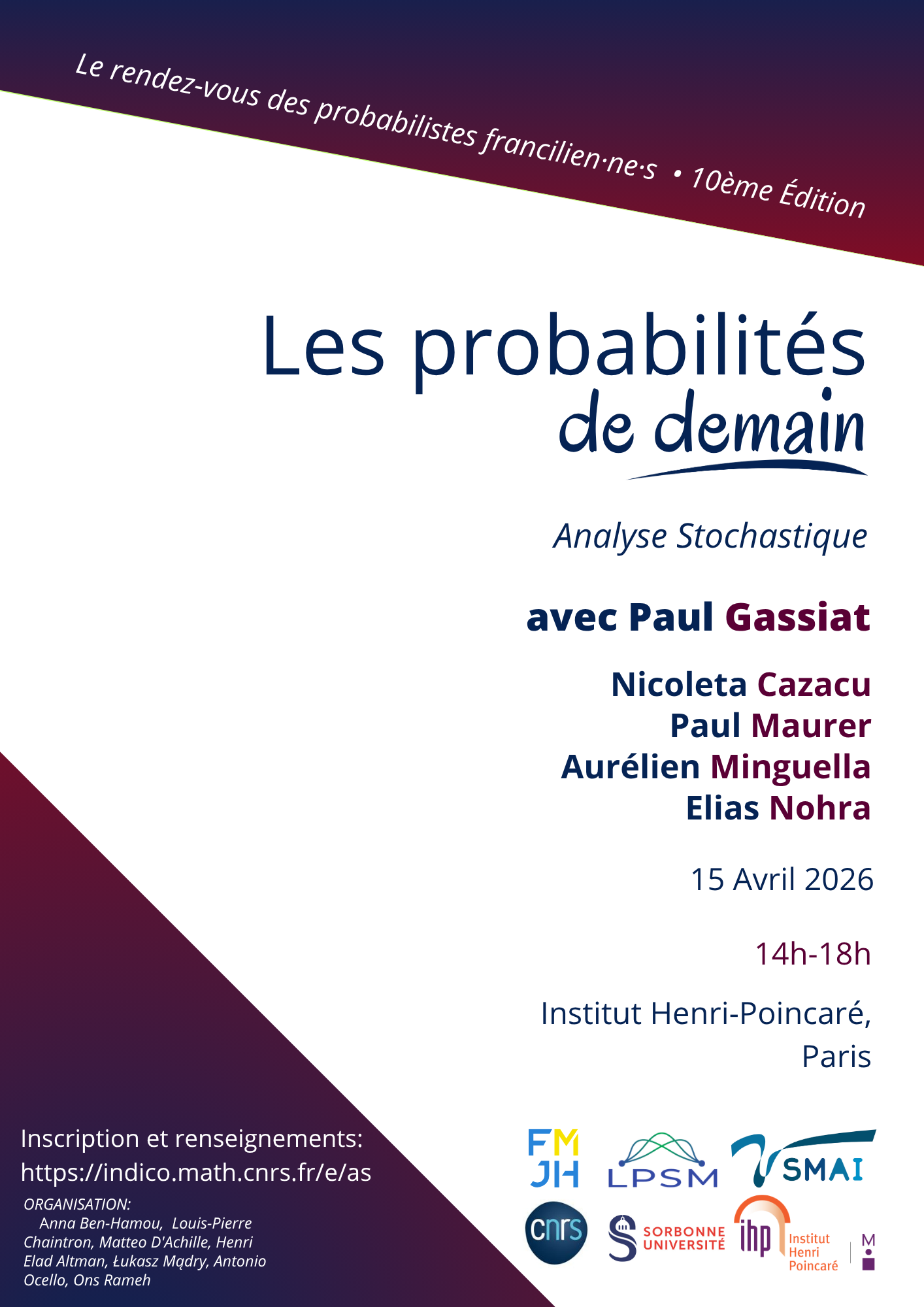
Dans de nombreuses situations, l’ajout d’un terme de bruit à une équation déterministe améliore le comportement du système. Cela peut prendre plusieurs formes, comme le rétablissement du caractère bien posé d’équations mal posées dans le cadre déterministe, ou encore l’amélioration des propriétés de régularité et de stabilité des solutions. Ce phénomène, appelé « régularisation par le bruit », constitue un domaine de recherche très actif. Son analyse mathématique repose généralement sur les outils du calcul stochastique.
Dans cet exposé, je présenterai d’abord ce phénomène dans le cadre simple des équations différentielles ordinaires à coefficients irréguliers. En particulier, j’expliquerai comment, pour des équations dont les coefficients sont seulement continus, l’ajout d’un bruit brownien additif rétablit l’unicité des solutions. Ce cas classique fournit une première illustration de l’effet régularisant du bruit et découle de façon assez directe de la formule d’Itô.
Je me tournerai ensuite vers des développements plus récents, en expliquant comment des techniques modernes permettent d’étendre ces résultats classiques à des classes de bruit plus générales. Si le temps le permet, j’évoquerai également des manifestations de la régularisation par le bruit dans d’autres contextes, tels que les équations aux dérivées partielles et la théorie du contrôle.
We study the renormalisation of singular SPDEs in the flow approach recently
developed by Duch. After giving a smooth introduction to the
method, we will give a general ansatz based on decorated trees for the solution of the
flow equation. The ansatz is renormalised in an inductive way, in the sense of the trees, via local extractions introduced for regularity structures. We derive the renormalised equation from this ansatz and show that the renormalisation scheme is identical to that appearing in the context of regularity structures, thus matching the BPHZ renormalisation. This is based on joint work with Yvain Bruned.
La théorie de Yang–Mills quantique décrit les interactions élémentaires à l’aide d'intégrales sur des espaces de dimension infinie, courbés et peu structurés. La construction rigoureuse de la mesure permettant de donner sens à ces intégrales demeure un défi mathématique majeur. Si aucune construction n’est connue à ce jour dans le cas d’un espace-temps de dimension 3 ou 4, le cas de la dimension 2 a été étudié avec succès par plusieurs auteurs. Dans cet exposé, je présenterai les objets mathématiques impliqués dans l'étude de la mesure de Yang–Mills en deux dimensions, ainsi qu’une contribution récente en collaboration avec Nguyen Viet Dang.
Deriving macroscopic evolution equations from interacting particle systems is a classical problem in mathematical physics. In the mean-field regime, such systems are expected to converge, as the number of particles tends to infinity, to solutions of nonlinear Fokker-Planck equations.
One particular challenge is to establish whether this convergence holds uniformly in time, especially for systems with singular interaction kernels.
In this talk, we first briefly review recent results establishing uniform-in-time propagation of chaos. We then introduce the framework of mollified interacting particle systems. Finally, we discuss recent work establishing quantitative uniform-in-time propagation of chaos for interaction kernels in L^p (p>d). The approach is based on a mild formulation of the limiting equation together with semigroup estimates.
Multifractal random measures, and in particular the one arising from the theory of Gaussian multiplicative chaos, are known to model the intermittency phenomenon in turbulence. In the Lagrangian setting, the latter can be approximated by an integrated Riemann-Liouville fractional Brownian motion when the Hurst parameter goes to zero. Using the functional Itô formula and the path-dependent Kolmogorov equation, we analyse the sensitivity with respect to the kernel of integrated Volterra processes, and we demonstrate that multifractal random measures may be weakly approximated by integrated sums of Ornstein--Uhlenbeck processes with an exponential rate of convergence.