TQFT and Knot Theory

Europe/Paris
Amphithéâtre Gaston Darboux (IHP - Bâtiment Borel)

Amphithéâtre Gaston Darboux

IHP - Bâtiment Borel

11 rue Pierre et Marie Curie 75231 Paris Cedex 05
Description

The Seed seminar of mathematics and physics is a seminar series that aims to foster interactions between mathematicians and theoretical physicists, especially among young researchers. It is structured into three-month thematic periods, the spring 2026 one being on TQFT and Knot Theory.

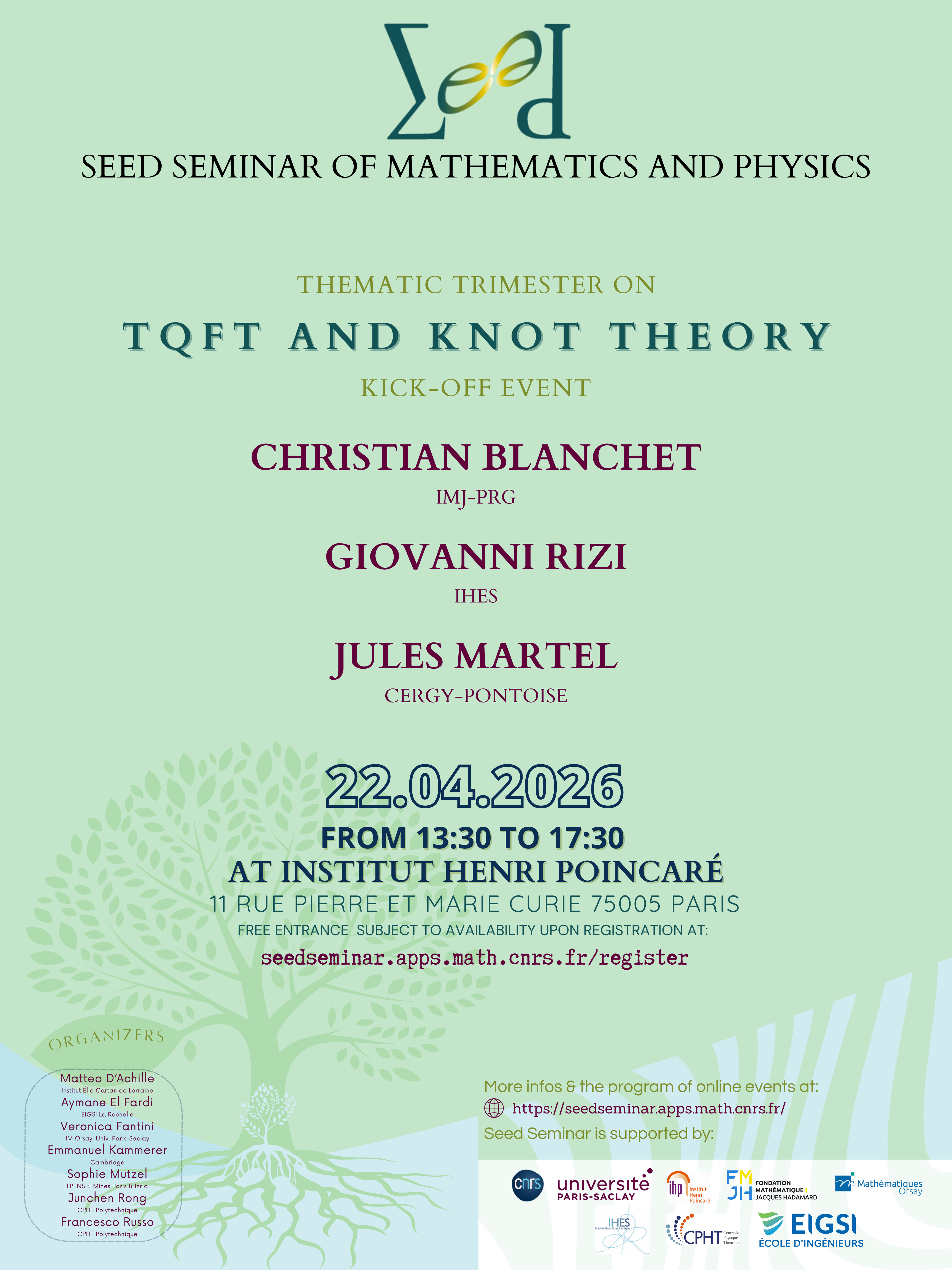
We open this thematic trimester with an in-person kick-off event at the Institut Henri Poincaré with contributions from Christian Blanchet, Giovanni Rizi and Jules Martel.

Registration for attending the event in person is free but mandatory, see Registration in the indico menu.

If you cannot attend the event in person but are interested in following the talks online, please register here anyway, specifying that you will be participating online when asked. Only those who have registered in this way will receive the Zoom link to participate.
Poster Seed seminar 28-01-2026
    • 13:30 14:30
      Introduction to non semi-simple TQFT 1h

      A Topological Quantum Field Theory in dimension 2+1 assigns to a
      surface a vector space (states), together with an action of mapping classes and more
      generally cobordisms. This includes invariants of 3-dimensional manifolds
      (correlation functions) possibly decorated with links or colored graphs. The starting
      point was the interpretation by Witten in the late 1980’ of the Jones polynomial
      invariant of knots in terms of Chern-Simons theory and the mathematical
      construction by Reshetikhin-Turaev of the expected model, now called WRT theory.
      WRT is based on simple modules over the quantum group sl(2) at root of unity, which
      means that an important part of the representation theory is neglected. Starting with a
      motivating example we will introduce to TQFTs which do use those neglectons. The
      non-simple TQFTs have two flavors. The graded version, first constructed by B-
      Costantino-Geer-Patureau involves manifolds with cohomology class (or abelian flat
      connection). The non graded version further developped by Marco de Renzi and
      collaborators recovers Kerler-Lyubashenko representations of mapping class groups
      on tensor powers of the adjoint representation. We will describe the constructions and
      the resulting TQFT spaces.

      Orateur: Prof. Christian BLANCHET
    • 14:30 15:00
      Coffee break 30m
    • 15:00 16:00
      TQFTs for physics 1h

      In this talk I will discuss some instances of how Topological Quantum Field Theories (TQFTs) appear and are used in high-energy physics contexts. TQFTs describe gapped phases of Quantum Field Theories (QFTs) and their relation with generalized symmetries makes them a useful classification tool for such phases. I will also highlight instances in which TQFT tools are useful beyond classification purposes and allow to describe more dynamical phenomena, such as modified crossing in 1+1 dimensional scattering processes. Beyond describing gapped phases, TQFTs are a useful method to describe the symmetry structure of general QFTs via the Symmetry Topological Field Theory (SymTFT) construction. Time permitting I will also discuss some connections between TQFTs with gravity and holographic dualities.

      Orateur: Dr Giovanni RIZI (IHES)
    • 16:00 16:30
      Coffee break 30m
    • 16:30 17:30
      Towards a homological reconstruction of TQFTs 1h

      TQFTs are the idea of Witten that we can study quantum field theories from the point of view of the topology of state spaces and of topological transitions. Mathematically, it was formalised by Atiyah as a linearization of a cobordism category. It was concretely realized by Reshetikhin--Turaev (RT) coupled with Blanchet--Habbeger--Masbaum--Vogel universal construction. The RT philosophy relies on a diagrammatic model for cobordisms (based on knot diagrams) and uses modules on quantum groups (or more generally monoidal categories) to model linearly these diagrams. This has more recently been extended so to permit the utilization of non semisimple monoidal categories as input of the construction giving rise to a new generation of TQFTs, for which a nice example is the Kerler--Lyubashenko (KL) construction. These constructions need abstract algebra tools applied on diagrammatic representations of manifolds, and we will try to avoid this by using homology theories, allowing a more global definition of TQFTs.

      In this talk I'll introduce a new philosophy to build TQFTs based on homology of configuration spaces. Representations of mapping class groups constitute an important
      byproduct of TQFTs, while more natural ones can be built out of twisted homologies of configuration spaces of surfaces. We will show that from this latter new framework we can recover
      step by step the properties of KL TQFTs associated with quantum groups and even a unifying framework. I'll stay introductory most of the talk but the constructions and their motivations will be the occasion to review joint works with: S. Bigelow, M. De Renzi, R. Detcherry or Q. Faes (depending on the time).

      Orateur: Dr Jules MARTEL (Université de Cergy-Pontoise, Pontoise, France)