Journée Analyse Appliquée Hauts-de-France

Europe/Paris
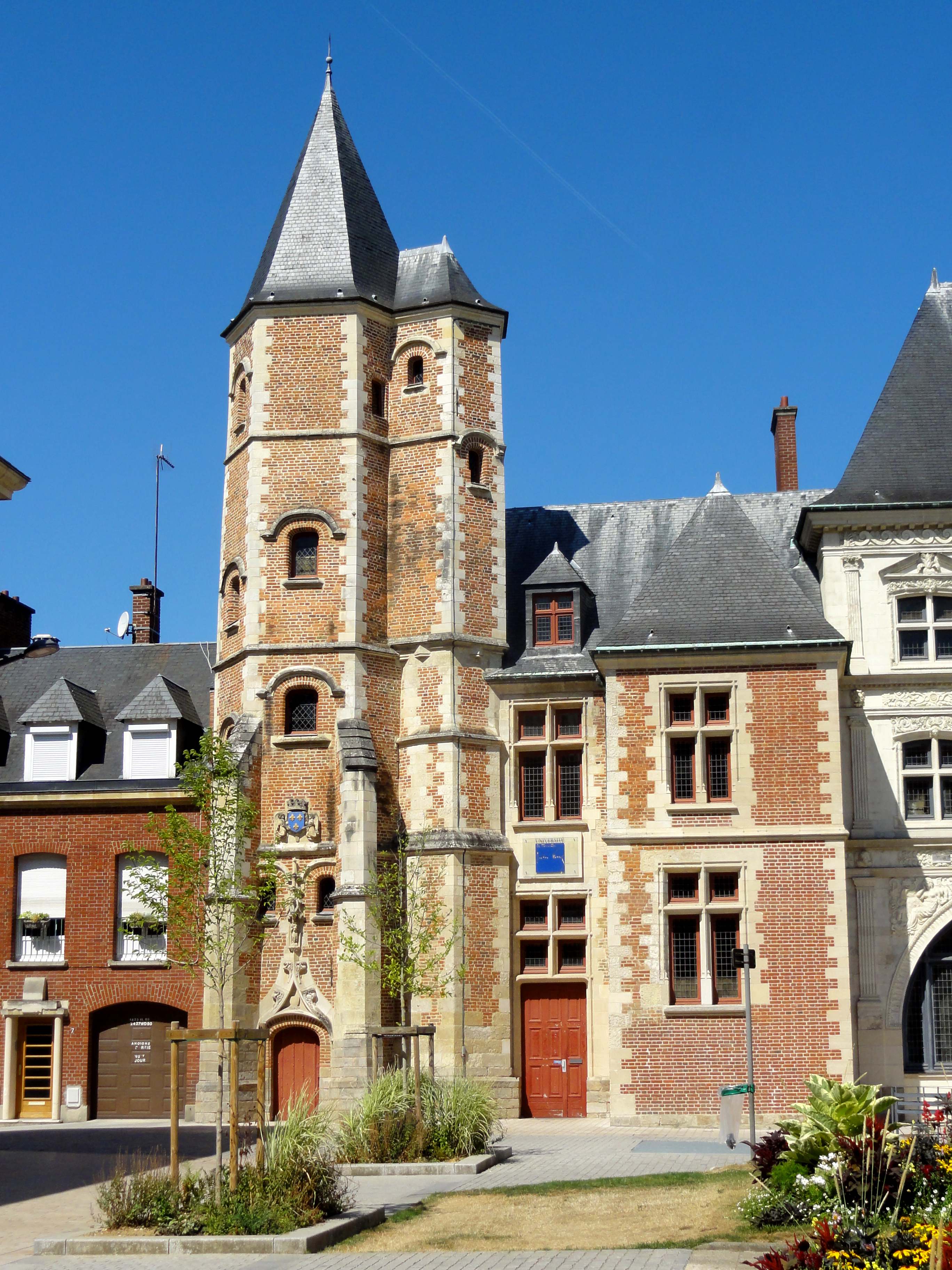
Logis du Roy (Université de Picardie Jules Verne)

Logis du Roy

Université de Picardie Jules Verne

Description
Présentation

Cette journée a pour but de rassembler les différents membres des laboratoires de la Fédération de Recherche Mathématique des Hauts-de-France travaillant sur les thèmes de l'analyse théorique et numérique des EDP autour de 4 exposés scientifiques. Pour cette édition du printemps 2026, l'évènement est organisé à Amiens par le LAMFA.

Orateurs et oratrices
Inscriptions

Inscription gratuite et obligatoire avant le 15 mai 2026.

Lieu

La journée se déroulera au Logis du Roy, en face du palais de Justice à moins de 10 minutes à pied de la gare d'Amiens (trajet).
 

    • 09:30
      Accueil

      Café, thé, viennoiseries, etc...

    • 1
      Marginal-constrained modified Wasserstein barycenters for model order reduction in quantum chemistry

      The aim of this work is to present new approaches to define Wasserstein-like barycenters for Gaussian distributions and Gaussian mixtures, while imposing the marginals of the barycenter. For instance, Wasserstein barycenters do not preserve marginals in general. In this work, we first characterize sufficient and necessary conditions for the Wasserstein barycenter between two Gaussian distributions to preserve marginals, and provide necessary conditions in the case of more than two Gaussians. This preliminary analysis enable us to propose modified Wasserstein barycenters that have prescribed marginals of the distributions, both for Gaussian distributions and for mixtures of Gaussian distributions. In the case of Gaussian distributions, the marginal-constrained modified Wasserstein barycenters can be analytically computed, while for Gaussian mixtures, computing the marginal-preserving barycenter consists in a postprocessing of the Gaussian mixture Wasserstein barycenter. In both cases, we provide numerical simulations illustrating the difference between Wasserstein barycenters and modified marginal-constrained Wasserstein barycenters. We illustrate the interest of the latter for interpolation tasks between probability measures. In particular, we motivate this work by applications in the constructon of reduced-order models in quantum chemistry, for electronic structure calculations in molecules.

      Orateur: Virginie Ehrlacher
    • 2
      La relativité numérique inscrite dans le complexe DivDiv

      Les équations de champ d'Einstein décrivent l'évolution de la métrique de l'espace-temps en fonction de la distribution de matière et d'énergie. Ces équations sont fortement non linéaires, doivent répondre à des contraintes implicites et ont tendance à donner des solutions dégénérées. Elles sont cependant indispensables pour comprendre les phénomènes relativistes, qu'ils soient dus à une extrême gravité, comme dans le cas de la fusion de trous noirs, ou bien à une très faible, comme dans le cas des ondes gravitationnelles. La résolution numérique de ces équations est généralement effectuée à l'aide d'approches numériques relativement simples, telles que les différences finies, qui combinent de nombreuses astuces et une grande expertise pour rendre les simulations possibles.

      Je vais présenter une approche alternative au problème que nous avons essayé avec Kaibo Hu. En nous basant sur les complexes différentiels et les discrétisations préservant la structure de type FEEC, nous avons abouti à une formulation des équations linéarisée sur le complexe DivDiv. Bien qu'elle soit encore loin de permettre la simulation de l'effondrement d'étoiles à neutrons, cette formulation présente de nouveaux avantages, comme la préservation exacte des contraintes, et prend une forme surprenamment simple. L'opérateur d'évolution devient alors une version alternée de l'opérateur de Hodge-Dirac. Je vais ensuite présenter la discrétisation proposée de cette formulation, ainsi que les résultats de convergence que nous avons pu dériver. Enfin, je conclurai par des implémentations numériques.

      Orateur: Marien Hanot
    • 12:00
      Repas

      Buffet sur place au Logis du Roy

    • 3
      Finite volume scheme for stochastic heat equation with transport noise in Stratonovich sense

      We prove that a finite volume approximation of a stochastic heat equation on a polygonal two-dimensional domain $\Lambda$, with multiplicative transport noise in the Stratonovich sense, satisfies a pathwise discrete energy estimate. Coupled with two possible strategies for the time discretization, this yields, almost surely, an $L^\infty((0,T);L^2(\Lambda))$ bound on the discrete solution $u$, as well as an $L^2((0,T);L^2(\Lambda))$ bound on $\nabla u$.

      These estimates are expected to be sufficient to pass to the limit in the numerical scheme and to prove convergence of the approximation toward the unique solution of the limiting equation. This is not a completely standard result since it is expected that there is a residual term in the limit equation which has the form of an additional second-order viscous term.

      Finally, I will illustrate the performance of the finite volume method with numerical simulations based on a two-point flux approximation.

      This is a joint work with Anne De Bouard and Ludovic Goudenège.

      Orateur: Flore Nabet
    • 4
      Mathematical analysis of the three-dimenional stationary exterior Stokes problem with Navier boundary conditions

      In this talk, we are interested in the three-dimensional exterior Stokes problem with the Navier slip boundary conditions, describing the flow of a viscous and incompressible fluid past an obstacle, where it is assumed that the fluid may slip at the boundary. Because the flow domain is unbounded, we choose to investigate the problem in weighted spaces in order to control the behavior at infinity of the solutions. This functional framework also allows to prescribe various behaviors at infinity of the solutions (growth or decay). Existence and uniqueness of solutions are shown in a Hilbert setting. Weighted Korn’s inequalities are the key point in order to study the variational problem. This is a joint work with Mohamed Meslameni and Anis Dhifaoui.

      Orateur: Ulrich Razafison