Orateur
Description
The study of extreme, or "rogue", waves in physical systems has gained significant attention, with the focusing Nonlinear Schrödinger (NLS) equation serving as a canonical integrable model. While much of the mathematical literature focuses on deterministic initial data, incorporating randomness is crucial to understand the emergence and structure of these extreme events.
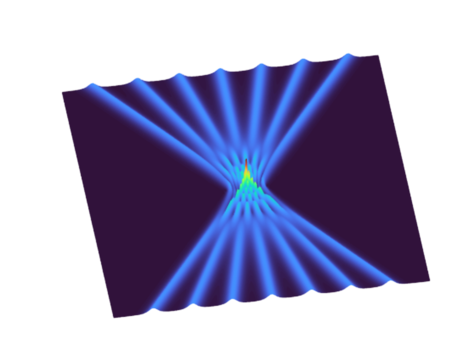
In this seminar, I will present different classes of NLS rogue waves with randomness. Specifically, we will focus on extremal $N$-soliton solutions that achieve theoretical maximal amplitudes, where the discrete eigenvalues are randomly drawn from sub-exponential distributions. By analyzing the underlying Riemann-Hilbert problems, I will show that the formation of these rogue waves is a universal phenomenon robust to randomness. We identify two distinct universality classes governed by the Painlevé-III and Painlevé-V equations.
This talk is based on recent joint works with A. Gkogkou, K. D. T-R McLaughlin, T. Grava, R. Jenkins, M. Girotti and M. Yattselev:
- Painlevé Universality classes for the maximal amplitude solution of the Focusing Nonlinear Schrödinger Equation with randomness, Aikaterini Gkogkou, GM, and Kenneth D. T.-R. McLaughlin, 2026, https://arxiv.org/2602.05101.
- Soliton synchronization with randomness: rogue waves and universality, Manuela Girotti, Tamara Grava, Robert Jenkins, GM, Ken McLaughlin and Maxim Yattselev, Nonlinearity, Nov 2025, https://arxiv.org/2507.01253.