Spin systems and phases of matter

Europe/Paris
Salle Maryam Mirzakhani (ex salle 201) (IHP - Bâtiment Borel)

Salle Maryam Mirzakhani (ex salle 201)

IHP - Bâtiment Borel

11 Rue Pierre et Marie Curie, 75005 Paris
Description

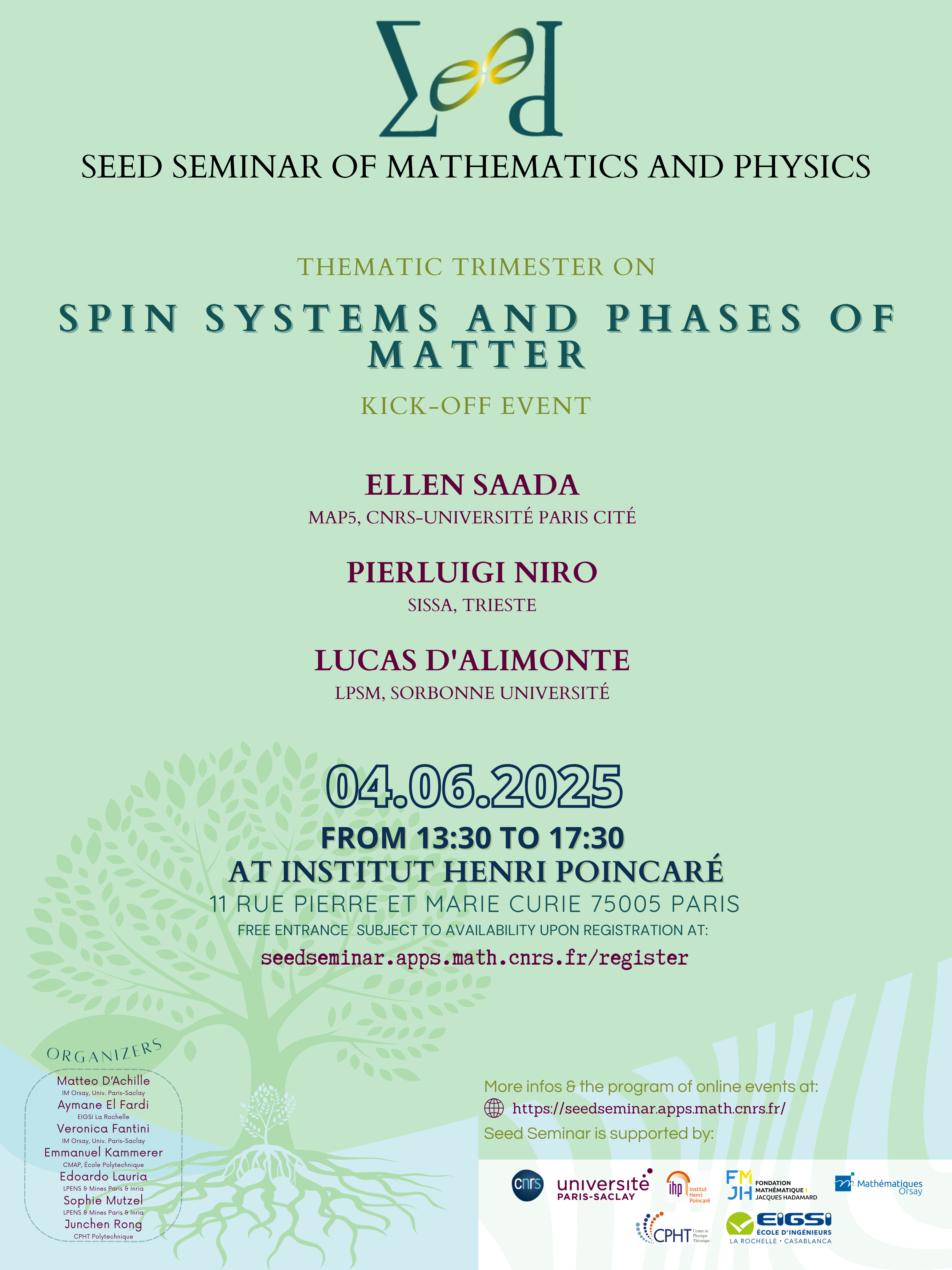
The Seed seminar of mathematics and physics is a seminar series that aims to foster interactions between mathematicians and theoretical physicists, especially among young researchers. It is structured into three-month thematic periods, the summer 2025 one being on Spin systems and phases of matter.

We open this thematic trimester with an in-person kick-off event at the Institut Henri Poincaré with contributions from Ellen Saada, Pierluigi Niro and Lucas D'Alimonte.

Registration for attending the event in person is free but mandatory, see Registration in the indico menu.

If you cannot attend the event in person but are interested in following the talks online, please subscribe here to the Seed seminar mailing list, on which Zoom links will be shared for this event and future ones.
Registration
Registration for "Spin systems and phases of matter" event
    • 1:30 PM 2:30 PM
      The two-lane exclusion process 1h

      We consider the simple exclusion process on $\mathbb{Z}\times\{0,1\}$, that is, a “horizontal ladder” composed of 2 lanes, depending on 6 parameters. Particles can jump according to a lane-dependent translation-invariant nearest neighbour jump kernel, i.e. “horizontally” along each lane, and “vertically” along the scales of the ladder. We investigate the extremal invariant measures, then the hydrodynamic behavior and local equilibrium of this model. We highlight new phenomena arising beyond the one-dimensional exclusion dynamics.

      Joint works with Gidi Amir, Christophe Bahadoran, Ofer Busani.

      Speaker: Ellen Saada (MAP5, CNRS-Université Paris Cité)
    • 2:30 PM 3:00 PM
      Pause café 30m
    • 3:00 PM 4:00 PM
      Symmetry breaking in 3d QED 1h

      QED in 2+1 dimensions is among the simplest and yet very rich examples of strongly interacting gauge theories, arising in many physical contexts. When the number of electrons is large, the theory is known to flow to a symmetry-preserving interacting CFT at low energies, but there is evidence that this scenario is excluded below some critical value of the number of electrons. Focusing on the case of two electrons, we argue that the theory must then spontaneously break its U(2) global symmetry to a U(1) subgroup via the condensation of monopole operators. This gives rise to a non-linear sigma model with target space a squashed three-sphere, equipped with a theta term required by anomaly matching. Time permitting, I will also discuss how this scenario is consistent with deformations of supersymmetric QED with eight supercharges.

      Speaker: Pierluigi Niro (SISSA, Trieste)
    • 4:00 PM 4:15 PM
      Pause café 15m
    • 4:15 PM 5:15 PM
      Ornstein—Zernike theory for the near-critical planar random cluster model 1h

      In this talk, we will discuss the classical Ornstein-Zernike theory for the random-cluster models (also known as FK percolation). In its modern form, it is a very robust theory, which most celebrated output is the computation of the asymptotically polynomial corrections to the pure exponential decay of the two-points correlation function of the random-cluster model in the subcritical regime. We will present an ongoing project that extends this theory to the near-critical regime of the two-dimensional random-cluster model, thus providing a precise understanding of the Ornstein-Zernike asymptotics when $p$ approaches the critical parameter $p_c$. The output of this work is a formula encompassing both the critical behaviour of the system when looked at a scale negligible with respect to its correlation length, and its subcritical behaviour when looked at a scale way larger than its correlation length. Based on a joint work with Ioan Manolescu.

      Speaker: Lucas D'Alimonte (LPSM, Sorbonne Université)