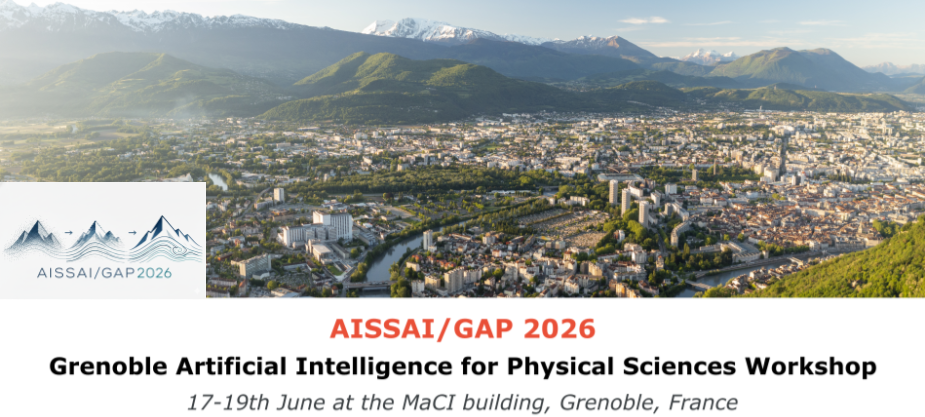
Description
AISSAI/GAP2026 is the second edition of the Grenoble AI for Physical Sciences (GAP) workshop, following the great success of its inaugural edition in 2024. GAP brings together international experts working at the intersection of artificial intelligence and the physical sciences, with a particular focus on inverse problems, simulation-based inference, data-driven discovery, and foundational models for science. The 2026 edition will continue to highlight cutting-edge advances in theory, algorithms, high-performance computing, and applications across domains such as climate and geosciences, astrophysics, neuroscience, and engineering systems. The format emphasizes pedagogical and forward-looking invited talks that introduce fundamental concepts and survey current challenges and research frontiers. We expect around 200 participants this year. In addition to invited talks, the programme will feature a poster session to showcase ongoing research, encourage exchanges among participants, and stimulate new collaborations across disciplines.
Online Attendance
No need to register for online attendance.
- Fellow the event live here: https://videos.univ-grenoble-alpes.fr/live/events/
- Interact on discord: https://discord.gg/pp5ZE9tF (best effort Q&A between attendees and speakers - We won't take live questions from discord though)
Location
Maison de la Création et de l'Innovation (MaCi) @ Université Grenoble Alpes
339 avenue Centrale
Domaine Universitaire
38400 Saint-Martin-d'Hères
Tram stop Gabriel Fauré
Keynote speakers
We will have the pleasure of having keynote talks of the following confirmed speakers:
- Linus Bleistein, EPFL
(foundational models for life sciences) - Patrick Gallinari, Sorbonne Université
(foundational models for scientific applications) - Samuel Hurault, CNRS, Université Gustave Eiffel
(diffusion models, flow matching, and inverse problems) - Ching-Yao Lai, Stanford University
(physics-informed deep learning for inverse problems) - Fanny Lehmann, ETH Zurich
(foundational models for geophysical sciences) - Jakob Macke, University of Tuebingen
(simulation-based inference) - Julien Mairal, Inria
(inverse problems for imaging) - Laurence Perrault-Levasseur, Université de Montréal
(bayesian methods for astronomy and cosmology) - Nelly Pustelnik, CNRS, ENS Lyon
(model-based neural networks) - Gabriele Steidl, TU Berlin
(generative modelling)
All presentations will provide a comprehensive overview of the field, equipping participants with the knowledge they need to delve into the specific applications and potential of machine learning in their respective domains.
Program
Wednesday 17/06
- 9h-9h30: Introduction
- 9h30-10h30: Julien Mairal, Inria. Inverse problems for imaging.
- 10h30-11h30: Coffee Break
- 11h30-12h30: Ching-Yao Lai, Stanford University. Physics-informed deep learning for inverse problems
- 12H30-14h: Lunch
- 14h-15h: Poster Fast Forward
- 15h-16h: Patrick Gallinari, Sorbonne Université. Foundational models for scientific applications
- 16h-16h30: Coffee Break
- 16h30-17h30: Gabrielle Steidl, TU Berlin. Generative modelling
Thursday 18/06
- 9h-10h30: Samuel Hurault, CNRS, Université Gustave Eiffel. Diffusion models, flow matching, and inverse problems
- 10h30-11h30: Coffee Break
- 11h30-12h30: Nelly Pustelnik, CNRS, ENS Lyon. Model-based neural networks
- 12H30-14h: Lunch
- 14h-15h: Linus Bleistein, EPFL. Foundational models for life sciences
- 15h-15h30: Coffee Break
- 15h30-16h30: Laurence Perrault-Levasseur, Université de Montréal. Bayesian methods for astronomy and cosmology
- 16h30-17h30: Poster Session
- 17h30-20h: Wine & Cheese Cocktail
Friday 19/06
- 9h-10h30: Jakob Macke, University of Tuebingen. Simulation-based inference (Talk+Demo)
- 10h30-11h30: Coffee Break
- 11h30-12h30: Fanny Lehmann, ETH Zurich. Foundational models for geophysical sciences
Attendance and registration
Register here (on-site attendance)
The key dates for attending the workshop on-site are:
- 17-April 2026 : deadline for poster submissions
- 01-May 2026 : notification of acceptance of poster submissions
- 01-June 2026 : deadline for all registrations
Poster session (closed)
Organizers
- Scientific Program and local organization:
- Jérôme Bobin, CEA Saclay
- Julien Le Sommer, CNRS, IGE
- Tobias Liaudat, CEA Saclay
- Thomas Moreau, Inria Saclay
- Bruno Raffin, Inria, LIG
- Pedro L. C. Rodrigues, Inria, LJK
- Administrative support:
- Gaelle Magand (LJK)
- Annie Simon (INRIA)
Sponsors
