Thematic 3-weeks programme at the Institut Henri Poincaré, Paris, June 15th to July 3rd, 2026.
Programme talks and conference are in amphithéâtre Yvonne Choquet-Bruhat in the new IHP Perrin building.
Beware: It was reported to us that scammers are sending to participants fraudulent e-mails about accomodation/fees. Please be particularly cautious about e-mails not coming from the organisers nor from an @ihp.fr address.
Presentation of the programme
Completely integrable systems have long served as pathfinders in mathematical physics.
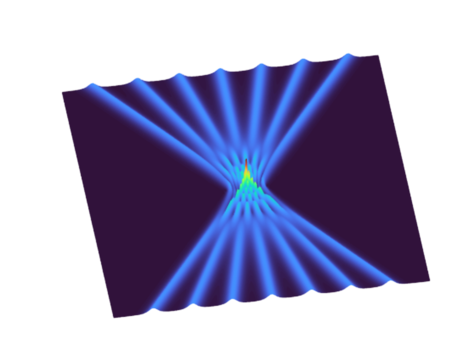
Integrable PDE are regularly used as effective models for a wide array of phenomena seen in nonlinear optics, magnetohydrodynamics, Bose–Einstein condensates, and for both surface and internal waves in fluid mechanics. That such a seemingly narrow class of equations should attract such enduring attention from generations of mathematiciansand physicists is indicative of several factors: these equations exhibit myriad physical behaviors, including the elastic interaction of solitary waves, the soliton resolution phenomenon, but also blowup, turbulence, and ergodicity. More strikingly, in the completely integrable context, it is sometimes possible to describe such phenomena with explicit formulae! Furthermore, these behaviours that were first witnessed in the completely integrable setting are robust enough to be observed not only in non-integrable analogues, but even in experiments.
In hindsight, it is not surprising that these phenomena were first described mathematically in the completely integrable setting. Indeed, the rich algebraic and analytic structure of these equations renders them amenable to treatment via tools and techniques from across a wide spectrum of mathematics, such as harmonic analysis, Lie theory, algebraic geometry, inverse scattering, partial differential equations, random matrices, etc.
This proposal focuses on analytical tools used in the study of completely integrable systems. Even in this realm there are a multitude of competing technologies, such as Riemann–Hilbert methods, the theory of Hankel and Toeplitz operators, the method of commuting flows, dispersive PDE techniques, and harmonic analysis tools. The goal
of the proposed program is to bring together experts on these multifaceted approaches, with a view toward creating a new generation of researchers that are multilingual and can seamlessly glide between the vocabulary and tools that are currently endemic to
each research group.
The program unfolds over three weeks: lectures and a workshop.
Introductory lectures: from June 15 to 19, IHP, Amphithéâtre Choquet-Bruhat - Perrin building
Workshop: "Modern methods, techniques & results in dispersive integrable equation": from June 22 to 26, IHP, Amphithéâtre Choquet-Bruhat - Perrin building
Invited lectures & talks: from June 29 to July 3, IHP, Amphithéâtre Choquet-Bruhat - Perrin building
Registration is free but mandatory.
Deadline for asking financial support: January 15th, 2026. Financial support is limited.
Deadline for registration : January 31st, 2026. Places are limited.
Organising committee:
- Patrick Gérard (Laboratoire de Mathématique d’Orsay)
- Tamara Grava (SISSA)
- Peter Miller (University of Michigan)
- Monica Visan (University of California)
Scientific committee:
- Hajer Bahouri (Laboratoire Jacques-Louis Lions - Sorbonne Université)
- Rowan Killip (University of California)
- Catherine Sulem (University of Toronto)
- Jean-Claude Saut (Université Paris-Saclay / CNRS Laboratoire de Mathématiques d'Orsay)
Fundings:
 |
 |
 |
 |
 |
The program receives also support from